
Ballina’s history re-written as First Nation voices take centre stage
Ballina’s public history is being re-written under a broader council-backed shift that places Indigenous perspectives at the forefront of how the town’s past — and future — are told.
The change is most visible along the riverfront, where new signage and an audio soundtrail replace earlier displays focused on the achievements of colonial settlement and river trade.
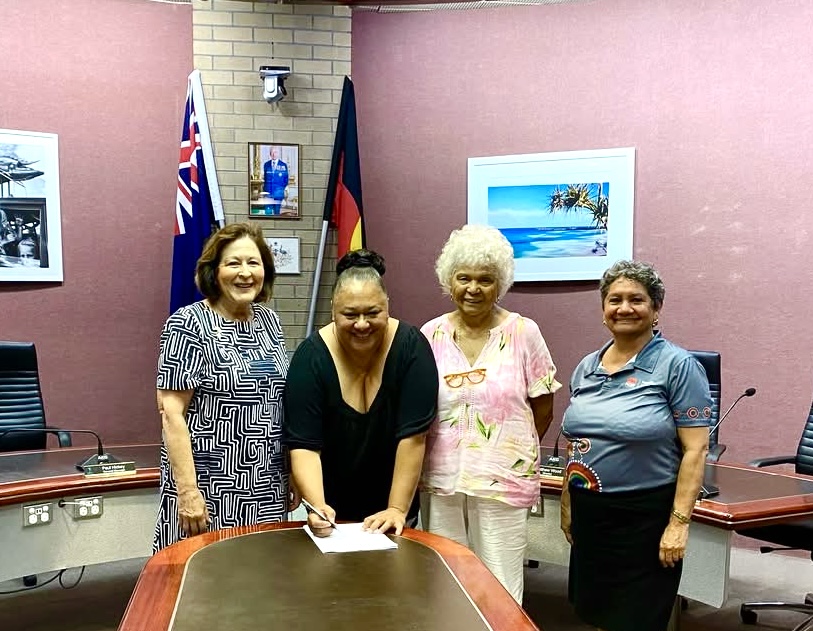
The project also coincides with a wider policy move by Ballina Shire Council, including a newly signed partnership agreement with the Jali Local Aboriginal Land Council that formalises Jali’s role in advising Council on cultural, planning and development matters across the shire.
The new riverfront signage, has seen former sign boards that detailed the achievements of Ballina’s early settlers replaced with with 23 new panels and a geo-located audio experience titled Water Stories and Soundtrail.
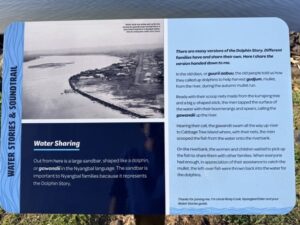
Above, one of the sign boards.
Main image: Mayor Sharon Cadwallader and Jali Local Aboriginal Land Council Chairperson Kylie Jacky sign the partnership agreement, joined by Aunty Sandra Bolt and Carmel Kapeen. (Source: Facebook)
‘Better understanding’ of the past
Under the new approach, Indigenous cultural knowledge and perspectives are presented first, with European settlement described in more disruptive terms.
One sign describes how river engineering altered the Richmond River, known as the Balun, to support commercial shipping.
It states that settlers “engineered, or changed, the environment” to protect profits, while breakwalls permanently altered sand movement and river behaviour.
Another sign recounts a Nyangbal cultural story describing how dolphins were trained to help to herd mullet during the annual autumn run.
According to the story, men tapped the water with boomerangs and spears to call dolphins upstream toward Cabbage Tree Island, where fish were netted.
The signage presents these accounts as stories passed down by Elders, forming part of Nyangbal cultural knowledge.
Mayor Sharon Cadwallader said the project aimed to broaden how Ballina’s past is understood.
“This project brings to life our riverfront and shares stories that help people understand more about Ballina’s history,” she said.
Significant deal – behind closed doors
The project also coincides with the signing of a new partnership agreement between Council and the Jali Local Aboriginal Land Council.
The agreement gives Jali a formal role in consultation on development, planning and cultural matters across the shire.
Council describes the agreement as “significant”, but it was signed in a closed session without media present and later announced only via social media.
The partnership outlines 21 actions, including improved Aboriginal employment outcomes, development of a Nyangbal cultural centre concept, and preparation of a management plan for the East Ballina Aboriginal Place.
Asked whether the agreement amounted to as a local indigenous “voice to council”, Mayor Cadwallader rejected the comparison.
“It’s no different to a chamber of commerce, a residents’ group or a progress association having a voice,” she said.
“Council needs to hear from all parts of the community to deliver projects properly.”
She said working with Jali was also a state legal requirement where Aboriginal land claims may be affected.
Mayor Cadwallader said all future decisions under the agreement would still come before Council in public meetings.
“There will be nothing done behind closed doors,” she said.
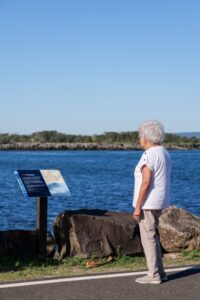
Aunty Sandra Bolt, viewing Water Stories signage along North Wall, East Ballina.
Local input, State-funded
Local historian Kate Gahan, who helped curate the new river-front signboards, said the project highlights the layered histories of Nyangbal and “settler-origin people” that sit side-by-side along the river.
“These stories reflect thousands of years of Nyangbal peoples’ connection to Country, as well as the complex histories that followed settlement.
“It’s a privilege to have worked with Nyangbal knowledge holders to bring these stories forward through a walk where people can hear, follow and reflect on stories told by local knowledge holders.” Dr Gahan said.
The project was fully funded by the NSW Government under the Local Infrastructure Recovery Package announced after the 2022 floods.