
Richmond river rescue plan set to become state election issue
Share This Story, Choose Your Platform!
Ballina Shire landholders could help end devastating Richmond River fish kills under a Tuckean Swamp restoration plan now being pushed into the state election debate.
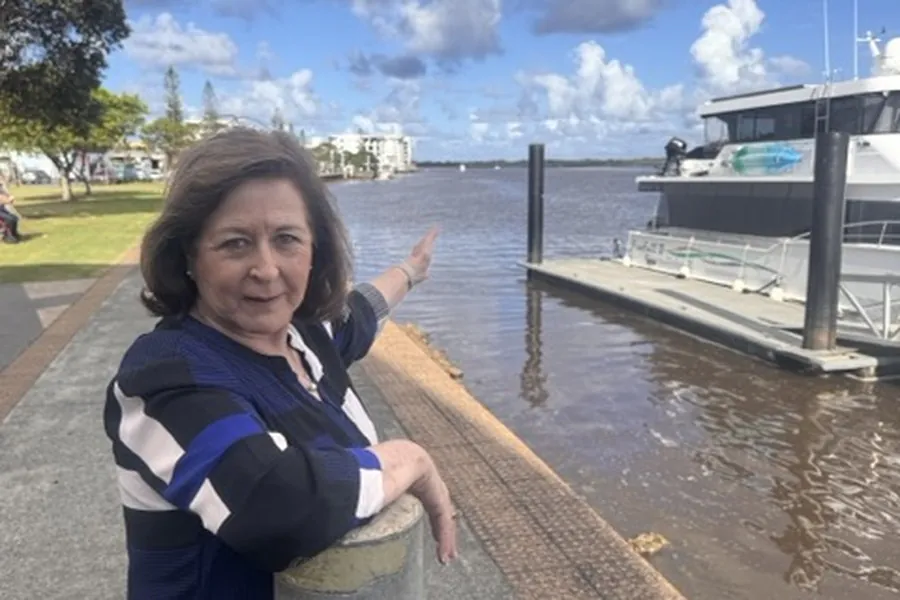
Ballina Shire Mayor and Rous County Council deputy chair Sharon Cadwallader says she will be calling on all local candidates to commit to funding what she describes as a nationally significant effort to restore the Richmond River.
The proposal, known as Operation Richmond River Recovery, focuses on voluntary changes to the lowest-lying parts of the floodplain, particularly within the Tuckean Swamp, where historic drainage has contributed to repeated blackwater events.
Cadwallader said the scale of past fish kills meant governments could not delay.
“We never want to see something like that again,” she said.
“It killed almost everything living in the river.”

Aerial view of the Tuckean near Meerchaum Vale (photo: NSW DPI)
A targeted solution
Research has identified that a relatively small portion of the floodplain is responsible for much of the damage.
Cadwallader said restoring degraded farmland to wetland habitat and blocking key drains could produce significant improvements.
“We’re talking about roughly 10.5 per cent of land creating around 55 per cent of the problem,” she said.
“That’s a huge return when you look at those numbers together.”
The approach would rely on voluntary incentives, staged land use change and environmental restoration rather than blanket buybacks.
Those involved in the project say the strategy targets the very lowest-lying areas where artificial drainage allows oxygen-poor water to surge into the estuary during floods.
Science behind the push
Speaking on ABC North Coast, Rous County Council flood mitigation manager Chrissy Clay said the proposal was developed after flooding linked to ex-Tropical Cyclone Alfred triggered a catastrophic estuary-wide fish kill last year.
She said blackwater occurs when water stripped of oxygen moves from drained floodplain areas into the estuary.
“We saw large volumes of deoxygenated water entering the estuary and overwhelming it,” Ms Clay said.
“We were recording oxygen levels of zero across large areas, and aquatic life simply can’t survive that.”

Rous flood mitigation manager Chrisy Clay, addressing the NSW Water Conference in Ballina last year (photo-LinkedIn)
Ms Clay said decades of drainage decisions had transformed former wetlands into agricultural land, increasing the risk of acid and blackwater impacts.
The proposal seeks about $70 million to support voluntary land use change and provide incentives for farmers in priority areas.
“We won’t eliminate blackwater entirely,” she said.
“But we need to stop catastrophic estuary-wide fish kills where every fish from Ballina to Coraki dies because there isn’t enough oxygen.”
Thousands of baby fish line the riverfront in Ballina during the black water event following Cyclone Alfred last year
Different from existing river programs
While Rous’ Watershed Initiative has focused on broader riverbank and catchment restoration, Operation Richmond River Recovery is understood to be a more targeted program aimed specifically at blackwater sources within the floodplain.
Planning work has identified the Tuckean area as a priority, with the strategy designed to be scalable and delivered in stages rather than as a single large intervention.
The approach reflects years of scientific analysis showing that relatively small, low-lying areas can disproportionately affect water quality across the estuary.
Funding call ahead of election
Cr Cadwallader said the upcoming state election to take place on March 13 next year created a critical opportunity to secure funding.
“The work undertaken by Rous backed by vast scientific evidence shows massive improvement can be made for a relatively modest investment, particularly when you consider the damage to our environment and the regional economy here, recurring after every flood event.
“As a community we need to make sure commitments are made and locked in for next year – we can’t afford to lose another four years,” she said.