

Major Airspace Changes Set for Ballina Airport in July
Share This Story, Choose Your Platform!
Airspace around Ballina Byron Gateway Airport will come under the control of air traffic controllers from July 9 as aviation authorities move to manage growing aircraft activity across the Northern Rivers.
The airport will transition from uncontrolled airspace, where pilots currently self-separate, to controlled airspace overseen by Airservices Australia.
The change follows a 2022 Civil Aviation Safety Authority airspace review, which found increasing operational complexity had changed the risk profile around Ballina Airport and identified the need for a higher level of air traffic management.
From July 9, air traffic controllers will manage aircraft movements in and around the airport, providing sequencing, instructions and traffic information to pilots.
Air traffic control services will operate daily from 7am to 8pm local time from a mobile control tower at the airport.
An Airservices Australia spokesperson told Ballina News Daily the move followed a CASA review that identified increasing operational complexity around Ballina Airport, requiring a higher level of air traffic management to maintain safe and predictable operations.
“Controlled airspace is being introduced following an airspace review by the regulator, CASA, which identified that increasing operational complexity had changed the risk profile in the Ballina airspace,” the spokesperson said.
“CASA determined that a higher level of air traffic management was required to ensure continued safe and predictable operations. Controlled airspace and air traffic control services provide that structured operating environment.”
The spokesperson said the initiative forms part of Airservices Australia’s broader airspace modernisation program, aimed at improving safety, efficiency and accessibility at major regional airports.
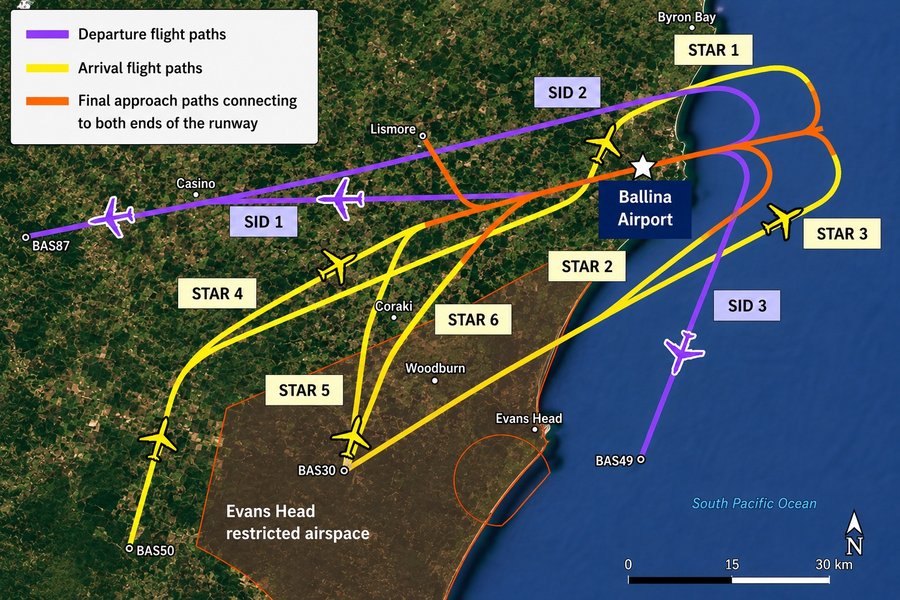
As part of the change, new standardised arrival and departure routes known as Standard Instrument Departures and Standard Arrival Routes will be introduced.
The routes, often described as roads in the sky, are designed to make aircraft movements more predictable and efficient.
Scheduled passenger flights and some business jet operators are expected to use the new routes.
Some aircraft, including training and recreational flights, will continue operating in a similar manner to current arrangements and may not use the standardised routes.
Residents May Notice Aircraft Flying Differently
The introduction of controlled airspace will result in changes to flight paths across parts of the Northern Rivers.
Airservices has said residents may notice aircraft operating differently in their local area once the new arrangements begin.
Communities around parts of Lennox Head, Tucki Tucki, Lynwood, Wardell, Alstonville, West Ballina, East Ballina and areas west of Ballina may notice aircraft using more predictable and concentrated routes than they do today.
Airservices Australia’s finalised flight-path map show’s new arrival and departure routes extending across the Northern Rivers, including flight paths passing near several communities before converging near Ballina Byron Gateway Airport.
Airservices undertook two rounds of community consultation during 2024 and continued engagement with community and industry stakeholders throughout 2025 before finalising the flight path design.
An environmental impact assessment completed in 2024 examined the proposed changes, including areas likely to experience changes in aircraft movements and aircraft noise.
Noise Monitoring Network Already Operating
Ahead of the changes, Airservices has established aircraft noise monitoring stations across the region to measure existing conditions and track any changes after implementation.
Noise monitors have been installed at Lennox Head, Lynwood and Tucki Tucki.
According to Airservices, the Lynwood monitor has been collecting information since November 2025, the Lennox Head monitor since December 2025, and the Tucki Tucki monitor since February 2026.
The Tucki Tucki monitor was originally installed at Ruthven but was relocated after background noise levels failed to meet monitoring requirements.
Residents can view aircraft noise monitoring information through Airservices Australia’s WebTrak platform, which displays data from the three local noise monitors and allows users to see where aircraft are flying around the Ballina region.
The monitors will continue recording aircraft noise following the introduction of controlled airspace, allowing Airservices to compare conditions before and after implementation while accounting for seasonal variations.
“Airservices intends to make aircraft noise monitoring information available following implementation of the new airspace arrangements,” the spokesperson said.
“This is required to allow comparison between the baseline conditions and the new operations allowing for seasonal variations.”
Community Feedback to Shape Review
Airservices will begin a community information campaign in June to remind residents about the upcoming changes and explain how feedback can be provided once the new arrangements are in place.
A public survey will be activated from July 9 to allow residents to provide feedback about the new flight paths and aircraft operations.
Feedback submitted through the survey, as well as reports made through the Airservices Noise Complaints and Information Service, will contribute to a Post Implementation Review expected about 12 months after the changes commence.
The review will compare forecast aircraft operations with actual flight data and assess whether any refinements, mitigation measures, safety improvements or efficiency improvements are required.
Airservices said the new arrangements must operate for at least 12 months before the review is undertaken to ensure a full year of operational and seasonal data is available.
The findings of the review will be released publicly.
Once the changes come into effect on 9 July, if you have operational enquiries about flight paths or concerns about aircraft noise, you can contact :
Noise Complaints and Information Service (NCIS)
Main Image: The Ballina Byron Airport departure and arrival flight paths . The flight paths accommodate arrivals and departures to both runway ends and are designed to allow for when the Evans Head military restricted airspace (RA) is active or inactive
Share This Story, Choose Your Platform!
One Comment
Comments are closed.




This is unbelievable that after 25 years of peace and quiet it now looks like we will be directly under the flight path at East Wardell