
New restrictions, captains quit: fresh crisis for Ballina jet boat
Share This Story, Choose Your Platform!
Two of Ballina’s most experienced jet boat operators have quit and the organisation that has supported the service since 1971 is preparing to wind up.
The developments have reignited questions about the future of one of the town’s most iconic rescue services, which has survived repeated threats to its existence over the past decade.
Concerns first emerged in 2014 when the NSW Government removed the jet boat’s rescue accreditation and designated Marine Rescue NSW as the primary responder for marine emergencies.
Those fears intensified in 2022 when Surf Life Saving NSW decided to withdraw from rescue jet boat operations altogether, placing the future of Ballina’s service in doubt.
A fierce campaign led by Ballina Shire Council, the late deputy mayor Eoin Johnston, Mayor Sharon Cadwallader and local volunteers ultimately convinced Marine Rescue NSW to take over the operation rather than see it disappear completely.
Today, with veteran operators walking away, new restrictions imposed on the vessel and the organisation that supported it for more than 50 years preparing to close, those questions have returned.
New restrictions spark concern
Veteran operators Dave Carter and Mark Puglisi say a series of new operating restrictions have left them questioning whether the jet boat can continue performing the role it was designed for.
Mr Carter said volunteers were recently informed the vessel would no longer be permitted to train in white water outside the Ballina Bar, except during an actual emergency.
He said the jet boat had also been restricted to operating within one nautical mile offshore, would no longer be permitted to tow other vessels and could only operate during daylight hours.
“So we can’t train to go in there, but if it’s an emergency, we can go in there,” Mr Carter said.
“There’s a gap there.”
Mr Carter said volunteers had received no explanation for the changes.
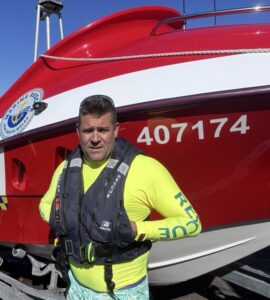
Resigned: Captain Mark Puglisi
“No one has said why they’re targeting this boat,” he said.
He said there was no indication the restrictions were temporary.
Mr Carter said Marine Rescue NSW Northern Commander Darren Hulm had instructed Northern Rivers Commander John Murray to amend the vessel’s Safety Management System to incorporate the new operating conditions.
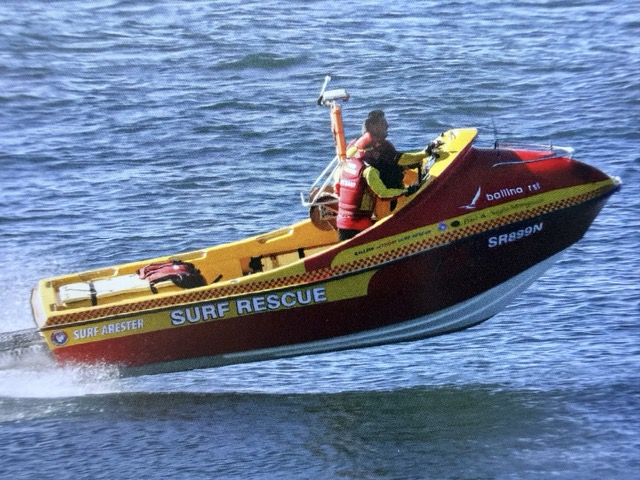
Unlike conventional Marine Rescue vessels, the Ballina jet boat was specifically designed to operate in white water and breaking surf conditions on the Ballina Bar. Its shallow draft also allows it to operate in areas inaccessible to larger rescue vessels.
Supporters say those capabilities make it uniquely suited to rescues on one of Australia’s most dangerous river entrances.
Captains walk away
The restrictions come as Mr Puglisi and Mr Carter step away from operational roles after decades of involvement with the service.
Mr Puglisi recently resigned.
Asked how many qualified jet boat operators remained, Mr Carter’s response was blunt.
“Pretty much none.”
He said another experienced operator was no longer available to serve, leaving the future of the specialised rescue craft uncertain.
The Ballina Jet Boat Surf Rescue Association itself now appears headed for closure.
Mr Carter said the organisation had originally planned to wind up after transferring its assets to Marine Rescue NSW, but recent events had accelerated concerns about the future.
“There’s no real future for us,” he said.
A Ballina institution
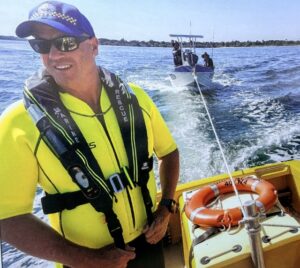
Jet Boat Surf Rescue Association President and Captain Dave Carter (Photo: Shipwrecked – Geoff Hutchinson)
According to local maritime historian Geoff Hutchinson, Ballina’s first rescue jet boat entered service on October 16, 1971.
Its first rescue occurred the very next day when a young boy was swept out to sea at Lighthouse Beach.
Over the following five decades, four generations of locally designed rescue jet boats served the Richmond River and Ballina Bar, responding to hundreds of emergencies.
The current vessel, christened as the Surf Arrester, entered service in 2011 and traces its origins to designs developed by local rescue boat captain and mechanical technician Ross Trease.
The service survived one major challenge in 2014 when the NSW Government removed its rescue accreditation.
The decision proved controversial. An article reproduced in Mr Hutchinson’s book notes that only a year earlier the Ballina jet boat had rescued the crew of a capsized Marine Rescue vessel on the Ballina Bar.
Warnings from 2022
When Surf Life Saving NSW announced plans to withdraw from jet boat rescue operations in 2022, Ballina’s was the last remaining rescue jet boat in NSW.
Speaking at the time, Cr Johnston described the service as “one of our leading lights”, noting it had performed almost 1,000 rescues in its first 50 years.
He also questioned whether Marine Rescue NSW would have the manpower, expertise and specialist training pathways needed to sustain such a unique operation.
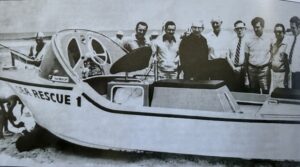
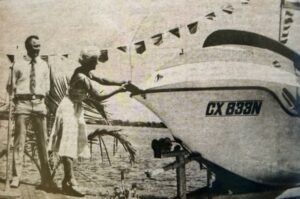
Above: the official handover of the first jet boat, Sea Rescue 1, pictured in the book Shipwrecked, with officials include Surf Club President Jack Trevan and Ballina Mayor Jack Easter. Below: Mrs Marie Trevan christens the second jet boat, named after her husband Jack in 1977.
Cr Johnston warned experienced volunteers might walk away during the transition and raised concerns about how the service would be maintained into the future.
Those concerns are now being revisited.
Mayor Sharon Cadwallader, who successfully lobbied for Marine Rescue NSW to take over the service, said the community deserved answers.
“The community did not fight to save this service only to see its future placed in doubt again,” Cr Cadwallader said.
“Any changes must clearly demonstrate that rescue capability will be maintained or improved, not reduced.
“Community safety must remain the overriding consideration in every decision that is made.”
Questions after the tragedy

The late deputy mayor Eoin Johnston, who was recognised for 60 years of service to Surf Life Saving NSW — the organisation that operated Ballina’s jet boat for decades — played a leading role in the successful campaign to save the service in 2022
The concerns have intensified following the May 4 tragedy that claimed the lives of Marine Rescue volunteers Bill Ewen and Frank Petsch.
Ballina News Daily understands the jet boat was deployed on the night Marine Rescue vessel BA30 capsized while responding to a yacht in distress.
However, it did was not permitted to undertake an offshore rescue operation due to it not having three qualified operators onboard at the time.
Many local mariners stress they are not seeking to pre-empt the findings of Marine Rescue NSW’s independent review or any future coronial inquest.
However, they argue the subsequent grounding of the yacht Victoria at Flat Rock demonstrated that maritime emergencies continue to occur and that questions about Ballina’s rescue capability cannot simply wait months for investigations to conclude.
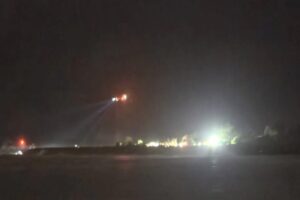
The Westpac Rescue Helicopter hovers above the South Ballina break wall on the night of May 4.
Mr Carter said the new daylight-only restriction also raised concerns because the Westpac Rescue Helicopter is unable to conduct over-water winching operations at night without suitable visual reference points.
He said surviving Marine Rescue volunteer Paul Griffith was fortunate on the night of May 4 that he was close enough to the South Wall for the helicopter crew to use it as a visual reference during the rescue.
“Another 100 metres offshore and they wouldn’t have been able to do it,” Mr Carter said.
Some experienced mariners have also questioned why NSW does not operate self-righting rescue vessels with inboard engines similar to those used by the Royal National Lifeboat Institution in the United Kingdom and Ireland.
Others argue Ballina already has the rescue capability it needs through the combination of larger rescue vessels and the specialised jet boat.
Their concern, they say, is whether the jet boat is being properly supported, crewed and utilised.
Marine Rescue responds
Marine Rescue NSW rejects suggestions the vessel is being sidelined.
“The jet boat is operational and there is rated crew able to operate the vessel when tasked for a mission,” a spokesman said.
The organisation said it continued to recruit volunteers and encouraged members to progress through training and operational ratings.
“We are always recruiting new members and encourage our volunteers to progress through training and ratings from vessel crew to Coxswain,” the spokesman said.
“Marine Rescue NSW provides full free training to members of the community who would like to support our mission of saving lives on the water as vessel crew or radio operators.”
Marine Rescue NSW is currently conducting an independent review into operational procedures following the May 4 tragedy.
The organisation has confirmed the review is being undertaken by an external maritime safety expert but has declined to identify the reviewer. It says the review will focus on operational procedures and will not accept public submissions.
For many in Ballina’s boating community, the immediate question is no longer what happened on May 4.
It is whether Ballina can afford to go without a rescue capability developed specifically for one of Australia’s most dangerous river bars.