
Could Ballina’s worst flood have been cut in half? CSIRO explains
Share This Story, Choose Your Platform!
What does the CSIRO flood modelling report mean for Ballina? We asked the lead scientist.
CSIRO hydrologist Dr Jai Vaze says the engineering works identified in the new $11.4 million Northern Rivers Resilience Initiative report could dramatically reduce flooding in Ballina during an event like the devastating 2022 disaster.
The report models the impact of constructing 10 flood detention basins across the Richmond River catchment, opening Boundary Creek during major floods and upgrading the Tuckean Swamp flood mitigation system.
Below is an edited transcript of Ballina News Daily’s interview.

Dr Jai Vaze
QUESTION: What impact would these works have on Ballina during times of flooding?
DR VAZE: I looked at three flood events.
In 2008 there was no flooding anywhere in the Ballina Shire. In 2017 there was a major flood in Lismore, but again there was no flooding across the Ballina landscape.
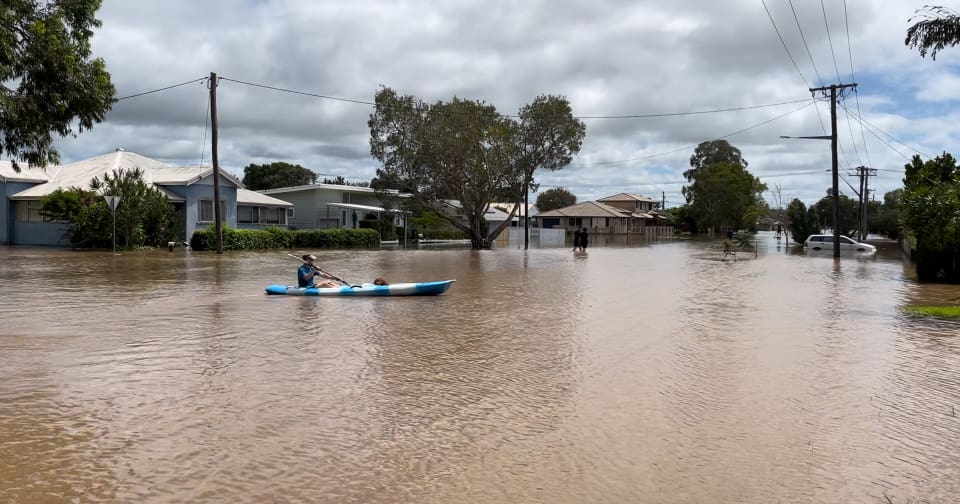
The 2022 flood was very different. There was extensive flooding through the Ballina CBD.
If the Bundle 2 engineering works had been in place, they would have reduced flood levels in Ballina by about half.
At the Ballina river gauge, the peak reached 2.39 metres on February 28, 2022. Our modelling shows that could have been reduced to 1.66 metres — a reduction of 73 centimetres.
That is a huge difference because Ballina is such a flat area. About 50 per cent of the properties that were inundated would not have flooded.
QUESTION: Does the report propose opening Boundary Creek permanently to the Pacific Ocean?
DR VAZE: No. It would only operate during major flood events.
For the 2008 and 2017 floods it would not have been activated. During an event like 2022 it would have opened, allowing a significant volume of floodwater to flow to the ocean, helping reduce flooding in Ballina and Wardell.
Importantly, we do not want salt water entering the catchment.
The proposal uses pressure-operated gates. When floodwater pressure from the Boundary Creek catchment becomes greater than ocean pressure, the gates automatically open to release water.
When floodwaters recede, the gates close again, preventing saltwater intrusion.
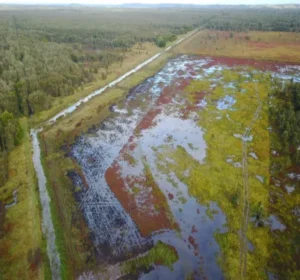
The Tuckean Swamp (photo: NSW DPI)
QUESTION: What changes are proposed for the Tuckean Swamp?
DR VAZE: The gates at the Bagotville Barrage, a flood mitigation structure built in 1971, are not operating as they were originally designed.
I have seen that myself.
We are simply proposing that they be restored so they function the way they were intended.
QUESTION: And what is proposed for Tuckombil?
DR VAZE: During consultation with cane farmers and Ballina Mayor Sharon Cadwallader, we learned there was previously an inflatable flood gate at the Tuckombil Canal.
These inflatable dams rise during normal conditions to stop saltwater entering farmland, then deflate during floods so water can escape quickly to the ocean.
Over time, that inflatable structure was deliberately removed and replaced with fixed concrete barriers about two metres high.
The problem is that water cannot escape until it rises above those barriers.
If sugar cane remains underwater for more than two weeks, the roots rot and the entire crop can be lost.
Farmers are calling for a return to pressure-operated gates instead of fixed concrete barriers, allowing floodwater to escape while still protecting farmland from saltwater during normal conditions.
QUESTION: These works are likely to cost billions of dollars, aren’t they?
DR VAZE: That’s true, but that’s outside the scope of my project.
I work for CSIRO, which is a scientific organisation.