

Inside the crisis threatening the NSW Nationals
Share This Story, Choose Your Platform!
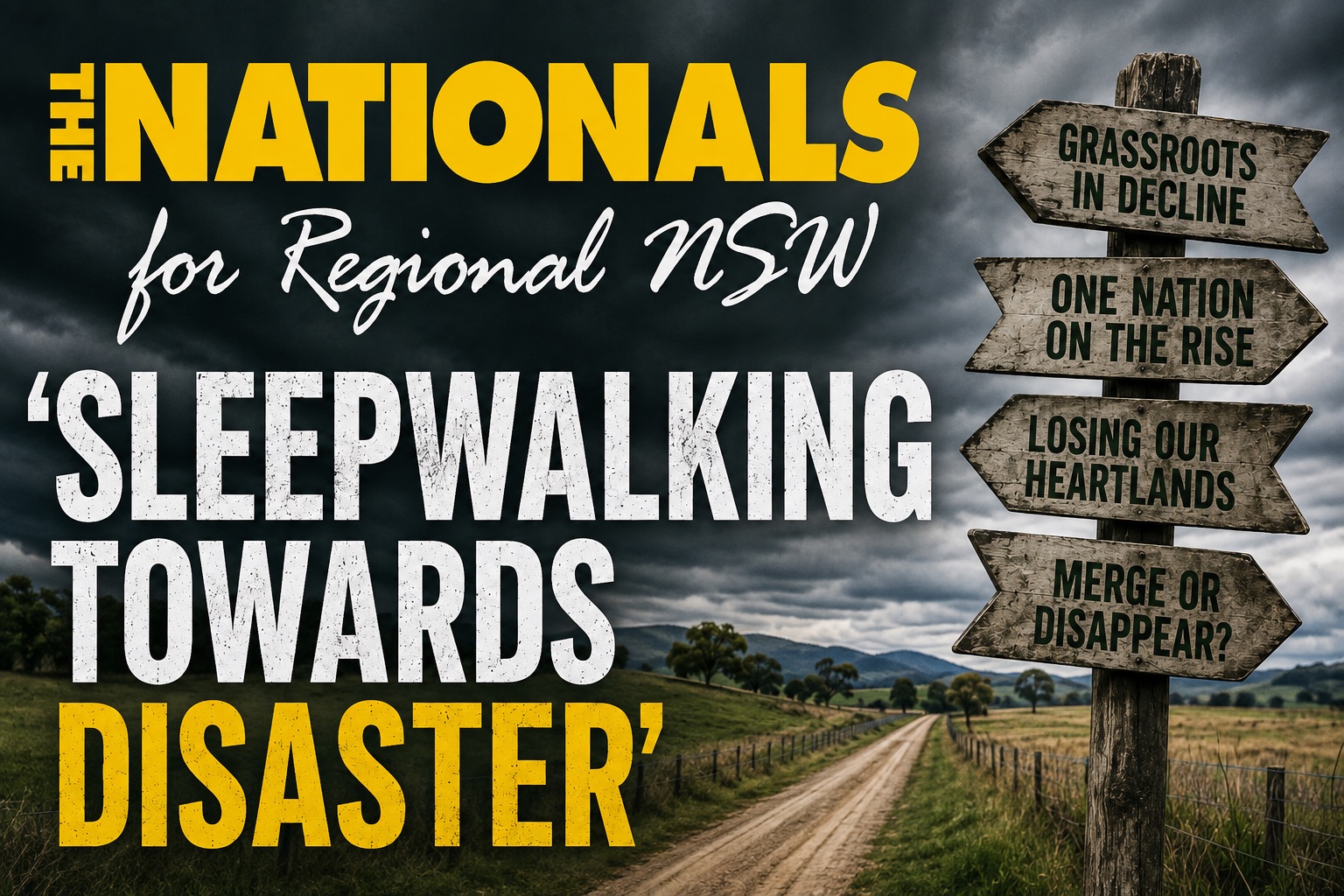
A long-time NSW Nationals insider has warned the party is “sleepwalking towards disaster” as it struggles to rebuild support in the region that helped create its political dynasty.
With less than seven months until the March 13 NSW election, the senior party figure has broken ranks to warn the Nationals risk losing not only seats and votes, but the grassroots organisation that sustained the former Country Party for generations.
And he fears the ultimate consequence could be the disappearance of the Nationals as a separate political force in NSW and a merger with the Liberal Party to create an LNP-style organisation similar to Queensland.
“There’s definitely some people that want that,” he said.
“I don’t want that at all.”
Ballina News Daily has agreed not to identify the source because he remains a committed Nationals supporter and has been involved in party organisation and election campaigns over many years.
He says he is speaking out not to damage the party, but because he believes there is still time to save it.
His warning comes as the Nationals struggle to rebuild in the Northern Rivers, including in Ballina and Lismore – electorates that were once regarded as natural National Party territory.
The Nationals lost Ballina to the Greens in 2015, while Labor’s Janelle Saffin took Lismore in 2019.
The party has struggled to settle candidates for the two seats ahead of next year’s election, according to the insider, who says the problems surrounding preselections are only the most visible symptom of a much deeper malaise.
He described declining membership involvement, difficulty finding election-day volunteers, poor communication between the state parliamentary party and grassroots members, tension between the state and federal organisations and growing frustration with the party leadership.
In some Northern NSW booths, he said, families and long-term members had once reliably staffed polling places election after election.
That accumulated local knowledge was now disappearing.

“What we had always, particularly in the Northern Rivers and northern New South Wales, was a dedicated core group of people who’d be out on booths,” he said.
“You knew that there was nearly a presence everywhere.
“Over the decades, that’s really slowed down, right up until now, where every booth we’re struggling to find people.”
He said the decline had reached the point where organisers increasingly struggled to find people with the local knowledge and experience required to run campaigns across individual communities.
The Nationals’ Northern roots
The Nationals’ problems in the Northern Rivers carry particular significance because northern NSW was not just a stronghold for the party — it helped shape and lead it.
Sir Michael Bruxner, a Tenterfield grazier whose name lives on through the Bruxner Highway, was one of the formative figures of the NSW Country Party and led it for decades.
Sir Earle Page, born in Grafton, was a founder of the federal Country Party and its longest-serving leader. He represented Cowper for almost 42 years and briefly became prime minister in 1939.
The North Coast went on to produce a remarkable succession of Country and National Party heavyweights. The Anthony family held the federal seat of Richmond across three generations, with Doug Anthony becoming federal leader and Deputy Prime Minister. He was later succeeded in Richmond by Charles Blunt, who also went on to lead the federal Nationals.
The Page political legacy also returned to Ballina through Sir Earle’s grandson Don Page, who represented the seat for the Nationals for 27 years until his retirement in 2015. At the election following his retirement, Ballina fell to the Greens.
More than a century after northern NSW helped build and lead the Country and National parties, the party is now struggling to rebuild in the region that produced some of its greatest names.
Where have the farmers gone?
Some of the organisational challenges confronting the Nationals are hardly unique to the party.
Traditional political parties have struggled with changing patterns of community involvement and a society in which fewer people appear prepared to devote weekends and evenings to branch meetings, fundraising and staffing polling booths.
But the Nationals’ predicament may be particularly acute because of who traditionally formed the backbone of the party.
For generations it was farmers, graziers and people closely connected to agriculture who filled country branches, staffed booths and provided the local networks that sustained the Country and National parties.
The party’s own history records that the Farmers and Settlers’ Association and Graziers’ Association between them had about 12,000 members in more than 400 branches when the NSW organisation was being established. Those organisations provided the backbone for the new party’s branch structure.
The insider says that connection with agriculture is now noticeably weakening.
He said younger members attending some Nationals gatherings had little direct connection with farming, agriculture or regional business – a stark change for an organisation created to give country communities their own political voice.
Other political movements have organisational advantages the Nationals increasingly lack.
Labor retains its historic relationship with the union movement and a strong potential organisational base among workers, including those in the burgeoning public sector.
The Greens meanwhile enjoy a generational advantage.
Environmental protection and the threat posed by climate change have been prominent themes in schools, universities and big business for more than a quarter of a century. A generation of younger Australians has grown up being taught that climate change represents an extisential threat.
The Greens have successfully positioned themselves as the party most closely identified with protecting the environment and confronting climate change, providing a cause capable of motivating younger supporters.
And while the established parties wrestle with political disengagement, One Nation is currently benefiting from the opposite phenomenon – enthusiasm among voters attracted to its message, including some who previously regarded the Nationals as their natural political home.
That leaves the Nationals confronting a more fundamental question than simply who will stand for them next March.
If the farmers and regional families who once formed the party’s grassroots army are disappearing from its meetings and campaigns, who replaces them?
One Nation threat
The immediate political threat identified by the insider is One Nation.
He claimed even some Nationals members of decades-long standing were considering voting for One Nation while continuing to renew their Nationals membership.
He believes the defection of former Nationals leader Barnaby Joyce to One Nation has been a significant factor in that shift.
The seriousness of the problem, he said, could be seen among people who remained emotionally attached to the Nationals but were nevertheless prepared to vote elsewhere.
Some had been party members for as long as 50 years.
But the insider does not believe One Nation is necessarily capable of replacing the Nationals as the enduring political voice of regional NSW.
Finding the right candidates, building the network of local branches, campaigners and community knowledge accumulated by the Country and National parties over generations would be difficult, he said.
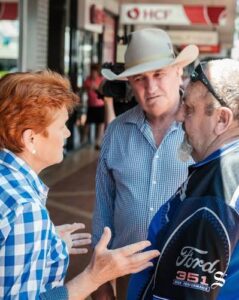
Yet to be proven: Pauline Hanson and Barnaby Joyce (Photo:Instagram)
His concern is that too many within the Nationals are complacently assuming One Nation’s resurgence will eventually collapse and its voters will return.
He estimated the party was divided between those who recognised the seriousness of the threat and those taking a “she’ll be right” approach.
“I’ve been told when I’ve said someone has left, ‘they’ll be back’,” he said.
He described that attitude as irresponsible.
The Nationals could recover, he believes, but there was no guarantee One Nation would collapse. Even if it did, there’s no guarantee younger regional voters will return to the Nationals.
“There’s not that brand connection with a new generation of people like there was for an older generation,” he said.
‘Sleepwalking’ towards trouble
Asked whether the Nationals were “sleepwalking” towards a potential electoral bloodbath next March, he agreed.
“Yeah, yeah, definitely,” he said.
But he was also cautious about predicting electoral annihilation, acknowledging One Nation still has to prove it can translate political momentum into credible candidates, effective campaigns and votes.
His greater fear is a long, incremental decline in which the Nationals lose members, volunteers, votes, money and organisational capacity election after election.
He compared it to a bouncing ball rising a little less each time until eventually it was “just trickling along”.
He also raised concerns about the party’s financial capacity, claiming resources were already stretched and warning that falling first-preference votes could compound the problem.

NSW Nationals leader Gurmesh Singh (right) with Page MP Kevin Hogan
He expects the limited resources available will need to be deployed propping up sitting candidates facing One Nation threats next March, rather than trying to win back seats like Ballina and Lismore – a reality that has possibly dissuaded credible candidates from coming forward.
The insider was critical of NSW Nationals leader Gurmesh Singh, although he acknowledged Mr Singh had been in the leadership for less than a year and deserved time to establish himself.
Mr Singh, the Member for Coffs Harbour, was elected NSW Nationals leader in November 2025.
The insider said Mr Singh presented well and had a strong regional and business background, but argued the leadership needed to engage far more directly with members, candidates, electorate councils and regional communities.
He claimed senior MPs sometimes visited regional communities without local party members even being told they were coming, wasting opportunities to build the party’s profile and grassroots organisation.
“There needs to be a bit of humility,” he said.
He described a culture of “no communication”, secrecy and centralised decision-making — an approach he regarded as particularly ironic for a party built around decentralisation.
He also claimed there had been a serious breakdown in communication between the state and federal wings of the party, including inadequate coordination of visits, policy and political activity.
Could the Nationals disappear?
The danger, he believes, extends beyond one poor election.
If the Nationals continue losing members and influence in regional NSW, pressure could build for the party to merge with the Liberals.
Queensland’s Liberal and National parties merged in 2008 to create the Liberal National Party.
The insider said there were already people within the NSW organisation who regarded an LNP-style structure as the way forward.
He strongly disagrees.
As the Nationals’ regional membership base contracts, he fears the organisation will become increasingly Sydney-focused and culturally closer to the Liberal Party.
For him, losing an independent National Party would also mean losing a political organisation whose primary purpose is advocating for regional NSW.
“That’s right, absolutely,” he said when asked whether regional issues would receive less attention without a separate party representing country communities.
The NSW Nationals continue to describe themselves as the only political party solely dedicated to representing people living in regional, rural and remote NSW.
Despite his frustration, the insider believes that role remains as relevant today as it was when the Country Party emerged more than a century ago.
And that is why he has decided to speak out.
The party can still recover, he says.
But assuming its traditional supporters will simply come home may be the most dangerous assumption of all.