
Passing the flame: The tragedy behind a remarkable Olympic collection
Share This Story, Choose Your Platform!
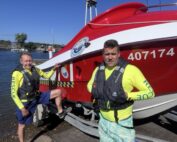
A terrible boating tragedy on Sydney Harbour almost 20 years ago set Robert Innes on a journey he could never have imagined.
It has taken him from grief and a campaign to improve safety on one of Australia’s busiest waterways to an Olympic torch relay, a collection of 43 torches and more than 130 presentations sharing the stories of the Games.
On Monday, that journey brings him to Ballina, where Innes will bring about 10 Olympic torches to Ballina Library for a talk that promises to be part history lesson, part show-and-tell and, inevitably, part of his own remarkable story.
It begins with his daughter Morgan.
Morgan Innes was just 14 when she was killed in the horrific Sydney Harbour boating collision of March 2007, when a Sydney ferry struck a pleasure craft beneath the Harbour Bridge. Three of Robert’s friends also died.
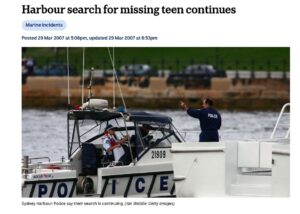
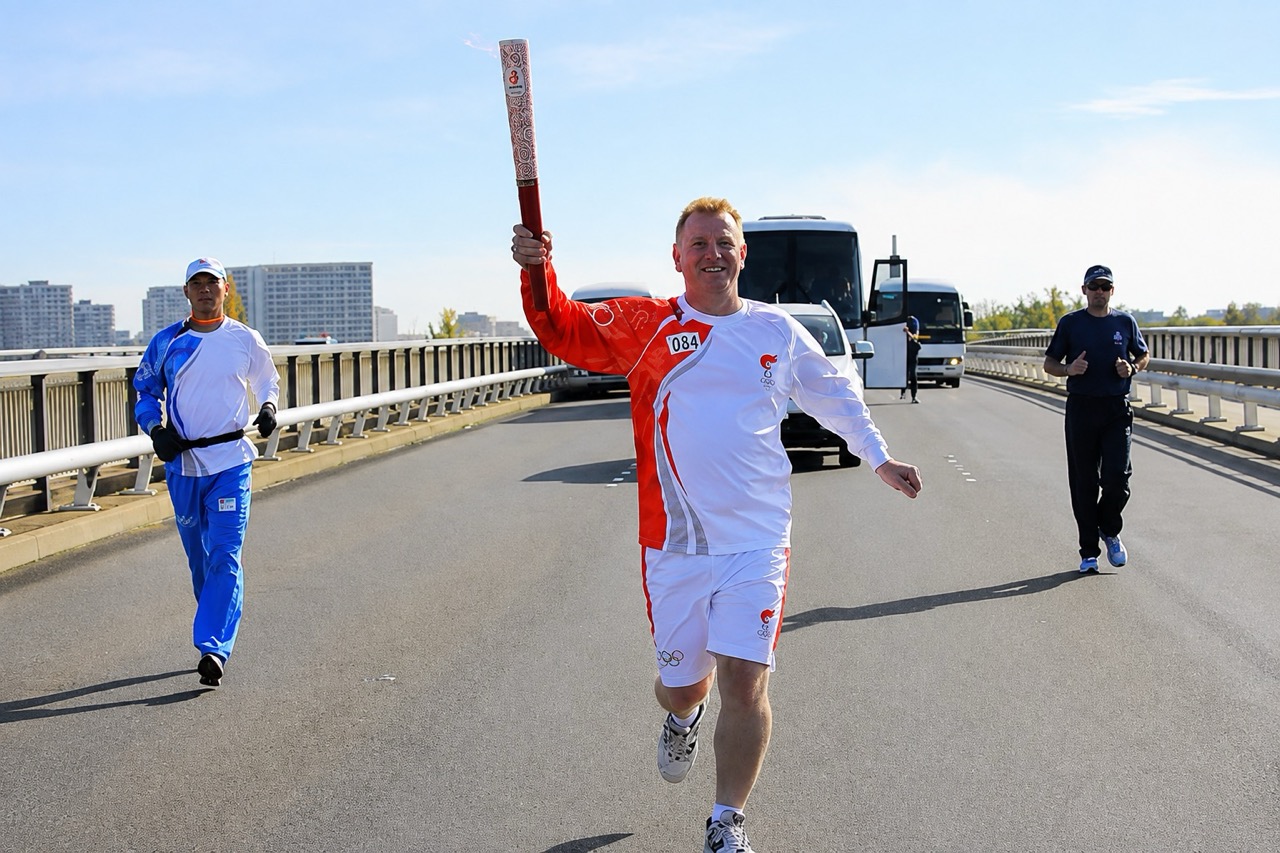
ABC News coverage of the 2007 boating accident. Main image: Robert Innes carries the Beijing Olympics torch in Canberra in 2008.
Morgan was a talented young athlete who had been Queensland figure skating champion, competed as part of a national championship-winning synchronised skating team, played No.1 tennis for her school and collected academic awards.
She had also dreamed, as so many young athletes do, of one day reaching the Olympics.
“The world missed out on the adult she would have become,” her father says.
In the aftermath of the tragedy, Innes threw himself into campaigning for changes to make Sydney Harbour safer.
Then, a year after Morgan’s death, something unexpected happened.
Without his knowledge, others nominated him to take part in the Australian leg of the Beijing 2008 Olympic torch relay. He was selected as one of 80 Australian torchbearers and travelled to Canberra to carry the flame.
It was there that fellow torchbearer and Australian marathon legend Robert de Castella planted an idea.
Innes could put his torch in a box and keep it as a treasured memento, or he could regard himself as its custodian — take it into schools, let people hold it and allow something normally experienced only once by a torchbearer to be shared again and again.
Innes chose the second option.
A torch becomes a connection
Soon afterwards, he and wife Kim were invited to the 15th birthday party of one of Morgan’s best friends.
It was an occasion he knew would be difficult, so he brought the Beijing torch with him, reasoning that if the emotions became overwhelming he could pull it out and let the teenagers hold it.
“It was a coping device,” he recalls.
When photographs of Morgan began appearing during the party, he did exactly that.
Then another extraordinary coincidence changed everything.
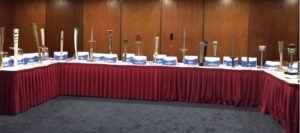
The Innes collection on display in Parliament House Brisbane in 2022
The birthday girl’s mother told Innes her father, George Stephanos, had carried Olympic torches in three relays — Melbourne 1956, Sydney 2000 and Athens 2004 — and still had the torches.
Innes was due to visit Morgan’s school and suggested they take the four torches along together.
From that first presentation, the collection — and Innes’ growing fascination with Olympic history — took on a life of its own.
Today Innes has 43 torches. His summer collection stretches across the modern Games and is complete apart from Paris 2024, while he also has every summer and winter torch since Nagano 1998.
But describing Innes simply as a collector misses the point.
Most valuable collections are protected behind glass. Innes wants people to touch his.
He estimates more than 50,000 people have held his Olympic torches since 2008 and regards himself not so much as their owner, but as the custodian of pieces of Olympic history that should be shared.
“I’m all about people holding Olympic torches,” he says.
That philosophy also explains why several exceptionally rare and valuable torches in his collection are replicas. An original Melbourne 1956 torch, for example, can command tens of thousands of dollars and Innes sees little point owning something so valuable he would be reluctant to put it into someone’s hands.
“I’m not a museum,” he says. “I don’t have them behind glass.”
His interest has taken him well beyond collecting and into the stories, science and sometimes strange history surrounding the Olympic flame.
His presentations can move from the evolution of torch design and the chemistry required to keep a flame burning safely, to the stories behind some of the Games’ greatest moments.
He particularly enjoys telling the stories people think they already know.
Take Steven Bradbury.
Australians remember the short-track speed skater winning gold after his rivals crashed in front of him, but Innes tells the bigger story — four Olympics, devastating injuries, years of training and a strategy that put Bradbury in position when opportunity finally arrived.
“For a guy that got lucky, he worked really hard for that luck,” Innes says.
It’s that message of resilience that resonates particularly strongly with him.
Almost two decades after Morgan’s death, the school visits and presentations still provide a quiet connection with the daughter he lost.
“When I see 14-year-old kids and they’re excited about doing something, well, then it’s an indirect connection to a very excited kid,” he says.
The stories behind the torches
Spend any time talking to Robert Innes and it quickly becomes apparent that collecting the torches is only part of the fascination — he has also collected the stories behind them.
The Olympic flame itself is an ancient tradition, but Innes points out that the torch relay as we know it today, carrying the flame from Olympia to the host city, dates only to the 1936 Berlin Olympics.
It is one of the more curious legacies of those Games, conceived in Nazi Germany but transformed over the decades into one of the great symbols of international sport.
And, as Innes discovered, the history of the torches is littered with experiments that didn’t always go according to plan.
“Everyone assumes it’s like magic; it just turns up,” he says.
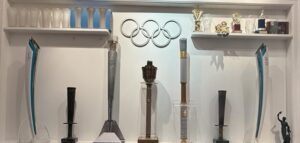
Part of Robert Innes’ collect on display in his Brisbane home, including (L to R) Sydney 2000, followed by Athens 1896, Salt Lake City 2002, Los Angeles 1984, Atlanta 1996 and Athens and Sydney again.
One of his favourite examples is Melbourne in 1956, when organisers worried the flame carried into the MCG by 19-year-old Ron Clarke wouldn’t be spectacular enough for the huge crowd.
“They were concerned that people in the stands wouldn’t be able to see the flames,” Innes says.
The solution was to add magnesium to produce a brighter, more dramatic effect. It certainly did that — but burning material also showered Clarke as he ran towards the cauldron, leaving him with burns.
Contemporary accounts confirm the Melbourne flame used naphthalene and hexamine, with magnesium added for Clarke’s final run to make it more spectacular.
“You have a look at his face,” Innes says. “He’s going, ‘Holy crap! This thing’s just going nuts.'”
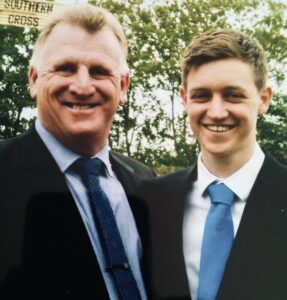
Robert with son Curtis, who he hopes will carry on the tradition.
The Melbourne torches are rare for another reason. Only 110 were purchased for the Australian section of the relay, meaning they were repeatedly collected from runners, serviced in mobile workshops and put back into circulation.
The technology has changed dramatically since then, something Innes became so interested in that he wrote a paper on the chemistry of Olympic torch design for school students.
“In 1968, a couple exploded and the torchbearers got burnt. That changed.”
Today his 43 torches trace much of that evolution in design, materials and technology — a collection intended to be handled rather than admired through glass.
Innes says there are only four other comparable collections in Australia.
Looking towards Brisbane
There may yet be another chapter when the Olympics return to Australia in 2032.
Innes, who will be 73 when Brisbane hosts the Games, says he would carry the flame again if asked, but what he would really like is for his son Curtis to become a torchbearer.
His ultimate hope would be for them to run consecutive legs, allowing him to pass the flame directly to his son.
“That would be incredibly exciting,” he says.
It would also provide a natural point at which Innes could consider passing on the collection itself, leaving Curtis to decide what its next chapter might be.
For Innes, there would be another significance to seeing his son join the relay.
“It’d be nice if that could happen because then Morgan’s thing goes on,” he says. “He gets to connect with his sister.”
For a man who hasn’t written a book, Innes has certainly accumulated enough stories for one.
On Monday, he’ll share some of them in Ballina — along with something even rarer: the opportunity to hold a piece of Olympic history.
See the Olympic torches in Ballina
Robert Innes will speak about his collection and bring a selection of Olympic torches for people to see and hold at Ballina Library from 10am on Monday, August 24.
The presentation is open to the public and Innes expects to bring about 10 torches from both Summer and Winter Olympic Games.
Afterwards, he will visit Ballina Coast High School to share the collection and its stories with students.