
How the Bondi massacre dragged two of Ballina’s best back to the worst of days
Share This Story, Choose Your Platform!
Last Sunday’s atrocity was one of those defining moments where people will always remember where they were when the news first reached them.
For two well-known Ballina community figures, it also dragged them back to the exact places they were standing when two earlier acts of mass violence forever altered their lives.
Cathy Gordon, founder and musical director of the Ballina Headliners Chorus, is a survivor of the Port Arthur massacre.
Damian Loone, Ballina’s Deputy Mayor, is a former NSW Police detective who was at the centre of the Martin Place Lindt Cafe siege.
Both say last Sunday’s Bondi attack reopened memories they have spent decades learning to live with, and both believe the hardest part for many caught up in Bondi may still be ahead.
Words spoken before the tragedy
Last Thursday, the Ballina Headliners Chorus was invited to perform at Ballina Shire Council’s final meeting for the year.
The all-female choir sang the national anthem, followed by a Christmas song.
At the end of the performance, Cathy Gordon stepped forward to deliver a brief, unscripted message to councillors and staff.
She spoke about kindness, respect and care for one another, particularly at times when communities feel tense or divided.
Those words, she later said, were shaped by lived experience.
Three days later, on Sunday night, the Headliners were back on stage.
They were singing at the Riverside Carols as news of the Bondi tragedy began to unfold in Sydney.
“We’d just finished singing,” Cathy said.
“That’s when it started to filter through.”
“It certainly triggers a lot of stuff”
Cathy said she tried to shield herself at first.
A friend warned her not to turn on the television.
But the next morning, she opened Facebook and saw a report that a child had been killed.
“That just completely undid me,” she said.
For Cathy, Port Arthur has never been something neatly confined to the past.
“You don’t get over it,” she said.
“It’s an injury.”
She said Bondi stirred memories she has spent years learning how to manage.
“It certainly triggers a lot of stuff,” she said.
At the time of the Port Arthur massacre, Cathy was simply doing her job.
She was working with the Tasmanian Symphony Orchestra, part of her responsibilities included looking after visiting conductors and soloists, many from overseas, and introducing them to Tasmania.
Port Arthur was one of the places she regularly took people.
“It was part of my work, and it was somewhere I had been many times before.”
Despite its violent history, Cathy said the site had always felt special to her.
“The water, the trees, the stillness,” she said.
That calm shattered without warning.
As a woman who grew up in regional Queensland, Cathy said she recognised the sound immediately.
It was live gunfire.
“There’s a crack in it,” she said.
Her reaction was instinctive.
She did not run.
She began moving people to safety.
There was another detail Cathy that has stayed with her.
She actually knew who the gunman was.
Hobart was, and remains, a small city and Martin Bryant was not a stranger to her. She had previously asked him to leave the building she was responsible for managing after he’d come in repeatedly and asked to use the toilet.
“He knew my face – and I knew his,” she said.
As Bryant went about his killing spree at Port Arthur, Cathy said she had just left the cafe precinct and was walking uphill towards the cathedral.
Ahead of her, a woman was walking towards the gunman with two children.
“He drove up and just shot,” Cathy said.
She narrowly escaped being killed. A high powered bullet passed so close to her head, it took a slice of hair from her temple.
Undaunted, Cathy continued to turn her focus to protecting others.
“I hid my people in the cathedral,” she said.
Believing the open ruins of the former convict settlement were far too exposed, she later moved them to nearby buildings, including a doctor’s house and the morgue.
“There were 18 of us,” she said.
They remained hidden for about two and a half hours. During that time, they could still hear gunfire and had no clear sense of where the shooter was.
Sound carried across the water.
“We didn’t know where he was,” she said.
When it was finally over, the trauma did not end.
“They were just walking around,” she said.
“The walking wounded.”
Cathy said survivors of Bondi, particularly children, will carry what they experienced for the rest of their lives.

Above: Cathy and her best mate Wales. “He died in 2013 , but he still guards my soul.”
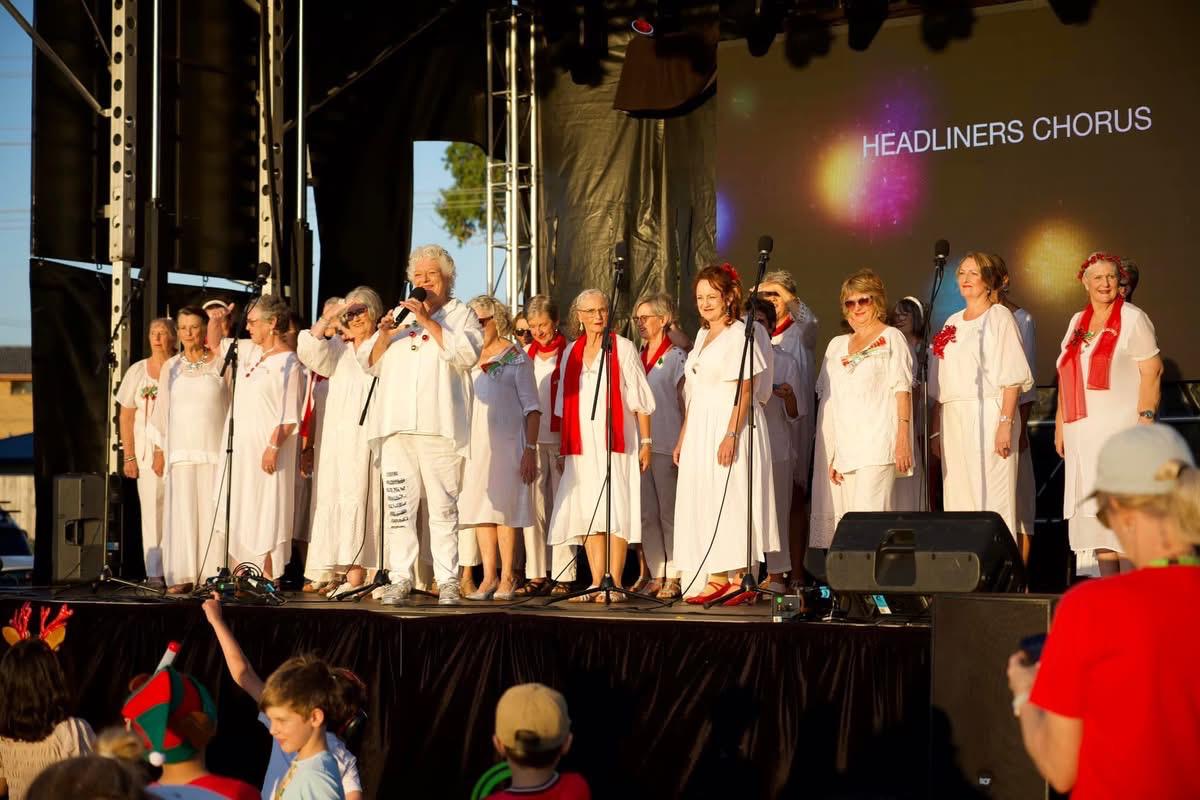
Main Photo, Cathy at the helm of the Headliners chorus in Fawcett Park on Sunday evening, just as news of the Bondi shootings started filtering through
Where healing began
What followed Port Arthur was not a clean recovery.
Cathy tried to keep working, but the psychological injury eventually caught up with her.
Healing, she said, did not begin in a counselling room or an office.
It began when she met a neglected horse called Wales.
Wales was in poor condition and close to being lost.
Cathy saved him and in the process, she says, Wales saved her.
Wales was a Waler, the legendary New South Wales horse breed that accompanied Australian soldiers in the cavalry of the Boer War and later in World War I, famous for their endurance, loyalty and quiet strength.
Those qualities mattered.
Cathy said Wales gave her stability when very little else could.
If she became overwhelmed, the horse would stop, remain calm and wait until she was safe.
“He protected me,” she said.
Eventually, Cathy moved with Wales to Ballina.
She settled in the Ballina Racecourse precinct, where horses, space and community became part of everyday life, and where rebuilding slowly began.
Damian Loone: experience forged in the hardest cases
Damian Loone’s response to Bondi is shaped not only by Martin Place, but by decades spent confronting violence and its aftermath.
Before entering local government, he served for many years as a senior NSW Police detective and counter-terrorism negotiator.
He is internationally recognised for his role in the decades-long pursuit of justice in the murder of Lynette Sims – the so-called “Teachers Pet” case that culminated in the conviction of former rugby league star Chris Dawson.
That reputation for persistence and empathy placed him at the centre of the Martin Place Lindt Cafe siege that happened in the week before Christmas back in 2014.
At the time, Damian was a detective sergeant at City Police Station and responded early.
He remained on duty until the siege ended.

Damian Loone
“It was a long day,” he said.
The next day, he was tasked with taking three toe tags to the deceased.
“It was horrendous,” he said.
The toll did not end there.
“It took me a long time to come back to work,” he said.
Damian said Bondi will leave lasting scars on first responders, witnesses and families.
“This will live with them forever,” he said.
He urged those affected to seek help early.
“If you need help, go and get it,” he said.
Different paths, shared understanding
Cathy Gordon and Damian Loone come from very different worlds.
One leads a choir that brings people together through music.
The other spent decades in policing and now serves his community through local government.
But they meet at a shared truth.

Damian Loone at a community forum with fellow councillor Erin Karsten
Mass violence does not end when the sirens stop.
Cathy said Jewish communities will draw strength from one another through shared grief and mutual support.
Damian said safety must include a sense of belonging, particularly for communities being targeted, and the ability to gather and celebrate without fear.
Experience shapes their views
Both Cathy and Damian support action to prevent future violence, but their views on gun law reform are shaped by different experiences.
Cathy questions why firearms should be kept in suburban homes of major cities where there is no demonstrable need for them.
“I don’t understand why somebody in suburbia needs a gun,” she said.
“And why do they need six?”
She supports firearms for genuine rural and professional use, but questions recreational ownership in residential settings.
Damian cautioned against believing firearms reform alone will address the deeper causes of violence.
“This is not the root cause,” he said.
He said extremist ideology and antisemitism must be confronted directly, and warned against rushing judgments before investigations are complete.
“There will be inquiries,” he said.
“I’ll wait for the evidence.”
New chapters
Both Cathy Gordon and Damian Loone eventually came to Ballina to begin new chapters of their lives.
For Cathy, that chapter grew into the Ballina Headliners Chorus, a choir now woven into the town’s civic and cultural life, bringing people together through music and shared moments.
For Damian, it has been local government, where in his first term he has earned respect for steady leadership, integrity and a deep understanding of the human cost behind public decisions.
Neither pretends the past disappears.
The scars remain, but both say healing does happen, slowly and unevenly, and often in ways that are only obvious with time.
They speak not of moving on, but of moving forward, helped by community, purpose and a willingness to lean on others when needed.
As Ballina heads toward Christmas, their stories offer a quiet reminder that even after profound trauma, new beginnings are possible, and life can still be rebuilt with care, patience and support.