

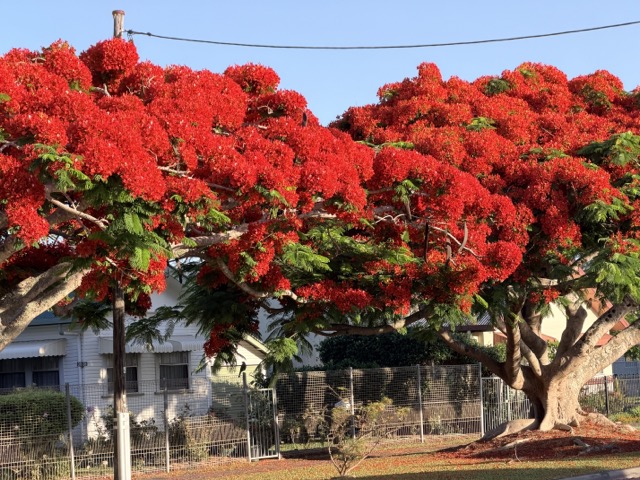
Poincianas: Pride of paradise – or pain in the proverbial?
Share This Story, Choose Your Platform!
Each spring, the streets of Ballina erupt in colour as poinciana trees burst into bloom, drawing admiration for their shade, scale and tropical character.
For some residents, they are a defining feature of the town’s identity, even prompting comparisons with Grafton’s famous jacarandas.
Neither tree is native to Australia. Poincianas originate from Madagascar, while jacarandas trace their roots to South America, both embraced over time as adopted symbols of their towns.
But beneath the red canopy, a quieter debate has been growing, one that goes beyond beauty and into questions of cost, responsibility and fairness.
That debate has sharpened as Ballina Shire Council places its Urban Vegetation on Public Land Policy on public exhibition, following renewed concerns from business owners about poinciana trees in the town centre.
While current council planting policy strongly prioritises native species, the poincianas reflect an earlier era of streetscape planning.
They were deliberately chosen during River Street’s major makeover in the early 2000s, following public consultation, when large exotic feature trees were still widely favoured for amenity and visual impact.
While the policy applies shire-wide, much of the current tension is centred on River Street, where large poincianas overhang shopfronts, awnings and flat roofs.

Flowering Poincianas framed with a giant Norfolk Pine – a species council considers both foreign and problematic due to its roots. It is no longer planted, despite its heritage streetscape appeal
River Street property owner Ian Wunsch says the issue is not opposition to trees, but the consequences of where and how they are maintained.
“They’re beautiful trees,” he said, “but they’re not appropriate where they are.”
Mr Wunsch says falling leaves, seed pods and branches create ongoing problems during winter, particularly for buildings with box gutters.
“We spend about $900 every time just to clean the roof from one tree,” he said.
“It rained not long after a clean and the gutters were blocked again.”
He says the burden is made worse by what he sees as uneven maintenance.
“The only tree that’s properly maintained is the one outside the Wigmore Arcade,” Mr Wunsch said.
“That’s a council-owned building. The others are allowed to grow much bigger.”
Mr Wunsch believes consistent pruning, rather than removal, would significantly reduce impacts.
“If they were kept to the same level as that one, a lot of this would be reduced,” he said.
The issue was raised at council’s November meeting during discussion of the vegetation policy review.
Cr Erin Karsten shared images showing flooding and damage linked to tree debris.
“This is more than leaf drop,” she said.
“It’s about the impact our decisions have on local businesses.”
However, other councillors were cautious about shifting responsibility.
Cr Phil Meehan, one of council’s longest-serving members, said the poincianas were selected after extensive public consultation during the River Street upgrade in the early 2000s.
“They create a beautiful aesthetic space, shade, colour and greenery,” he said.
“They contribute a great deal to the vibrancy of River Street.”
Cr Meehan acknowledged the tension between public trees and private buildings, but said property owners also have obligations.
“The private structure hangs out into the public space,” he said. “That’s the reality.”
He said building owners need to manage their own awnings and guttering, even where they extend over public land.
“An appropriate cleaning regime, gutter guards and maintenance all play a part,” Cr Meehan said.
Mayor Sharon Cadwallader echoed that view, warning against creating expectations that council would manage leaf drop for individual properties.
“We have to be very cautious about maintaining a position of strength around our urban green room,” she said.

Council staff advised that leaf drop is not considered a valid reason for pruning or removal under NSW law, a position supported by Land and Environment Court rulings.
The policy report notes that requiring council to manage leaf litter would significantly increase costs and could lead to pressure for widespread tree removal.
One example cited in the report valued a single poinciana tree at more than $40,000, underlining the financial implications of removal.
The draft policy does not recommend removing poincianas or changing council’s stance on leaf drop.
Instead, it reinforces existing principles around tree protection, biodiversity and long-term canopy cover.
The policy is now on public exhibition until January 16, with councillors encouraging affected residents and business owners to make submissions via the council website.
Mr Wunsch says he hopes the process leads to a more practical outcome.
“A good prune in early June would make a big difference,” he said.
For now, the poinciana remains both emblem and irritant.
Whether it stands as Ballina’s pride or a persistent pest for some may depend less on the tree itself, and more on how responsibility is shared beneath its branches.
Share This Story, Choose Your Platform!
One Comment
Comments are closed.




Please don’t take the poinciana trees out. They are the life and soul of River Street with their colour and shade.