

COMMENT: A murky river and mounting questions: Ballina deserves clarity
Share This Story, Choose Your Platform!
This week it was revealed that police numbers across the state are critically low, with fewer officers per person, high vacancy rates and many more off the road on leave at any given time.
It raises an uncomfortable but unavoidable question.
Is this why things are not being done as thoroughly, or as quickly, as the public expects?
Because here in Ballina, two recent cases have left the community waiting for answers.
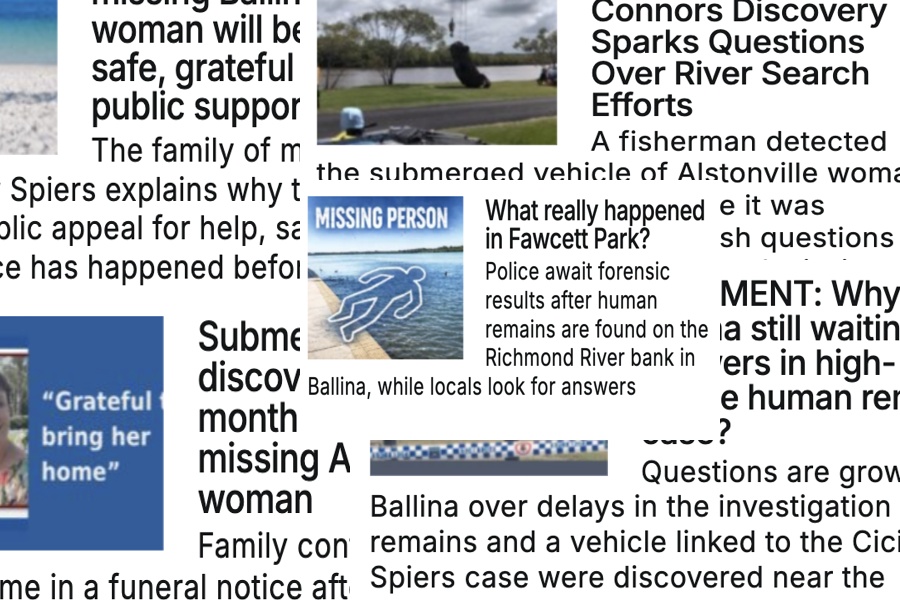
More than a month after human remains were discovered on the banks of the Richmond River, forensic testing has still not publicly confirmed their identity.
In the case of missing woman Sue Connors, police only issued a public statement after her family posted a funeral notice, despite her vehicle having been located in the river days earlier.
And as Ballina News Daily revealed this week, that same vehicle had in fact been detected months earlier by a local fisherman using sonar, but was not reported to police at the time.
His wife told us she had to push him to come forward, saying he “didn’t have confidence that anything would get done”.
That detail is as troubling as the timeline itself.
What’s sitting on the riverbed?
If resources are stretched, the question is whether that pressure is being felt in the way searches are conducted, or in how information is shared with the public.
Local fisherman Graham, who witnessed the Connors vehicle being recovered, told our reporter that he’s aware of at least six other vehicles sitting on the riverbed in the Emigrant Creek area alone.
If that is the case, then the obvious question is why those vehicles have not been systematically located, identified and investigated.
As many readers pointed out in response to our reporting, this is not an issue unique to Ballina.
One commenter, Zo Lovell, pointed to a group in the United States known as Adventures With Purpose, which uses sonar technology to locate submerged vehicles and has helped solve missing persons cases, some dating back decades.
The comparison is difficult to ignore.
Because it suggests this is not an unsolvable problem, but one that can be addressed with the right focus and resources.
Missing people, unanswered questions
Other readers pointed to long-standing missing persons cases in the region, including Ellen Wilson, who has been missing since 2015 along with her vehicle, and the recent disappearance of Yvonne Whear.
There is no evidence to suggest those cases are linked to submerged vehicles.
But the fact those questions are being asked reflects a growing unease.
That unease is particularly strong when it comes to missing women.
In December, Ballina community worker Mark Ross publicly raised concerns about the early search for Cicily Spiers, saying that items linked to her were found near the river soon after she disappeared and that this should have triggered a stronger and more immediate response.
Police have said searches in that case involved marine, aerial and land-based operations.
Yet as more details emerge, questions remain about how those searches were carried out and what they ultimately uncovered.
If local fishermen can locate submerged vehicles using basic sonar equipment, it is entirely reasonable for the community to ask whether official search methods are keeping pace, particularly in cases where vehicles remain unaccounted for.
A system under pressure
Set against the backdrop of a police force under pressure, those questions take on added significance.
At the same time, there is another issue that cannot be ignored.
The condition of the Richmond River.
A river that may contain multiple submerged vehicles is not just a policing issue, it is an environmental one, raising broader questions about monitoring, maintenance and responsibility across multiple state agencies.
These are not abstract concerns.
They sit firmly within the domain of state government.
And they are likely to remain part of the public conversation as the next state election approaches.
Ballina News Daily has put detailed questions to NSW Police about both the Connors and Spiers cases, including timelines, search methods and forensic testing.
Those questions remain unanswered.
People understand that investigations take time and that forensic work must be done properly.
But they also expect transparency.
And they expect urgency.
Finally, it is worth acknowledging that our coverage of these issues has attracted criticism.
The reality of reporting on local news means reflecting both the joys and strengths of a community and the unfortunate sorrows and challenges it faces.
We undertake this work with genuine empathy and respect for the families and friends involved, but the fact is these cases have also unfolded in the public domain.
The wider community was invested in the search for answers.
It is entirely reasonable for that same community to expect clarity about what has happened, and confidence that the issues now being raised are being taken seriously and addressed.
Earlier Story: Susan Connors discovery sparks questions over river search efforts
Share This Story, Choose Your Platform!
2 Comments
Comments are closed.



The river needs dredging badly. Locals can’t use the river like they did any more. A recently visitor said they have a yacht and then and all their friends never travel to Ballina any more because they can’t get their yachts in, its too shallow. We are missing out on a lot of tourism because boaties know not to come now. Sad situation.
Before we moved to Ballina back in 2007 we had seen plans for a marina which was definitely one of the pluses, apart from family reasons for moving here. This never eventuated and as a result we kept our boat up at Southport due to the difficulty of getting in& out of the river. A marina would’ve been a huge asset to Ballina & would’ve been a welcomed stopover for yachties between Yamba & Southport as well as bringing a great atmosphere to Ballina & the river. A pity this has never happened.