
Ballina massacre remembered as friends begin history-making walk
Share This Story, Choose Your Platform!
While many Australians their age spend their holidays trekking national parks or visiting famous landmarks, two Goonellabah men today began a far more confronting journey — walking nearly 500 kilometres between sites linked to some of the nation’s darkest frontier clashes.
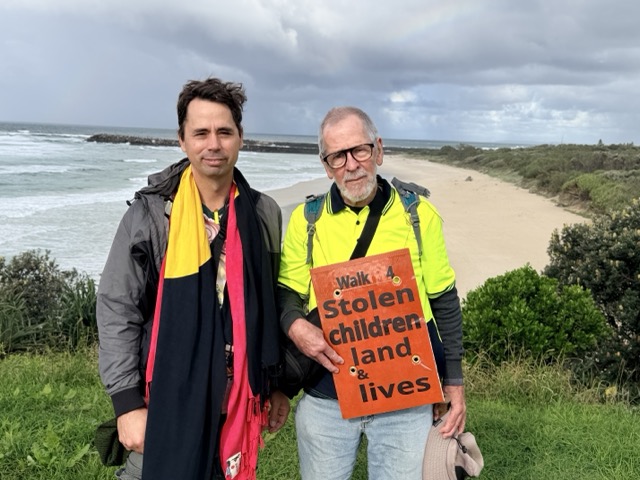
Geoff Reid and Daniel Peterson set off from East Ballina this morning on a 474-kilometre walk to the Myall Creek massacre memorial near Inverell, hoping to encourage reflection about Australia’s frontier history and reconciliation journey.
Their starting point near the East Ballina cemetery and Angels Beach is itself associated with violent clashes between Indigenous people and colonial forces during the expansion of the colony northward.
The pair first met while studying at Southern Cross University before later strengthening their friendship behind the barricades during the Bentley anti-coal seam gas protest.
Over the coming weeks, they plan to walk through Evans Head, Broadwater, Pagan’s Flat, Bluff Rock, Deepwater and Torrington before eventually reaching Myall Creek.
They hope to arrive at Myall Creek in time for the site’s annual reconciliation gathering, where descendants of both settlers and Indigenous families come together in remembrance and reconciliation.
Reid said the idea for the walk emerged after the failed Voice referendum left him feeling reconciliation efforts had suffered a major setback.
“I felt, well, what can I do to help keep it in the front of people’s minds?,” he said.
The journey was first announced about a year ago, with the men spending months planning the route, contacting Aboriginal Land Councils and organising support crews. They are joined by friends Ann and Phill Jarman and Virginia White who are helping provide logistical support along the way.
Peterson, who is studying history through the University of New England after earlier studies at Southern Cross University, said the pair had been careful to consult Indigenous groups.
“We have explicitly made contact with each and every local Aboriginal land council,” he said.
Tomorrow morning the group plans to visit Goanna Headland at Evans Head, where historical accounts describe a major frontier massacre involving Indigenous people being driven onto the headland by armed settlers and police.
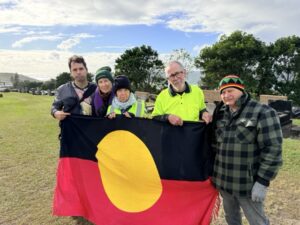
Main photo: Daniel Peterson and Geoff Reid were greeted by a rainbow over the heads as they made their way from the East Ballina cemetery this morning. They were joined on the first leg by support crew (above, L to R) Virginia White, Ann and Phill Jarman, who will be following them in a back-up van all the way to Myall Creek.
Reid said many Australians still knew little about frontier violence.
“My history book in high school had one page that mentioned there were even Aboriginal people here,” he said.
The men acknowledged they may face criticism during the walk, particularly in regional areas where the Voice referendum was strongly rejected.
Reid said he expected some may dismiss the exercise as “woke virtue signalling”, but he’s not bothered by that.
“Call it what they will,” he said.
“If we can raise a little bit of awareness, especially if this sort of walk grows in future years from different directions around the country, that would be wonderful.”
The pair are already considering repeating the concept in future years by walking different routes linking other massacre and frontier conflict sites around Australia.
Peterson said the walk was ultimately about understanding and humanity.
“It’s important we recognise each other’s humanity,” he said.
He said places connected to frontier violence formed an important part of Australia’s shared history.
“Awareness of those parts of our history adds to the complexity of our understanding of who we are,” he said.
“It’s a complex country with complex histories and that needs to be recognised.”
The Myall Creek massacre remains one of the best-known frontier atrocities in Australian history because several perpetrators were eventually prosecuted and hanged — a rare outcome during that era.
It is believed at least 28 unarmed Aboriginal people — mostly Wirrayaraay men, women and children — were killed on June 10, 1838.
The annual reconciliation gathering at Myall Creek now brings together descendants of both the victims and early European settlers in a shared act of remembrance and reconciliation.
What happened at the East Ballina massacre site?
A plaque at the Angels Beach memorial site states that Bundjalung people were killed in the area in either 1853 or 1854.
It says a group of mounted troopers and trackers travelled from Ballina and surrounded a large camp of Aboriginal people sleeping near the present-day reservoir area.
“The troopers and trackers stealthily surrounded the slumbering people and at a given signal opened fire on men, women, and children without mercy.”
It says about 30 Aboriginal people were killed outright and many others wounded.
The memorial also states local Ballina settlers reportedly condemned the attack and warned authorities it could lead to further conflict.
The plaque was erected by Aboriginal and non-Aboriginal Australians “in an act of reconciliation, and in acknowledgement of the truth of our shared history”.
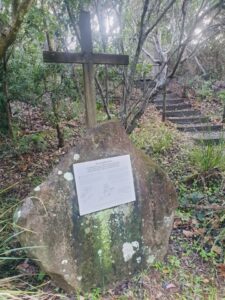
The plaque commemorating the massacre at Angels Beach.