

Higher density, higher tensions: Residents battle building boom
Share This Story, Choose Your Platform!
Residents who moved to Ballina for peace, privacy and water views say they are now facing a new reality as higher-density development reshapes some of the town’s oldest neighbourhoods.
Long-time locals and newer retirees alike say recent planning changes encouraging infill housing and more intensive development are leaving homeowners feeling powerless as neighbouring buildings rise closer to boundary fences and into sightlines that once felt protected.
For Tricia Packham, the issue has become deeply personal.
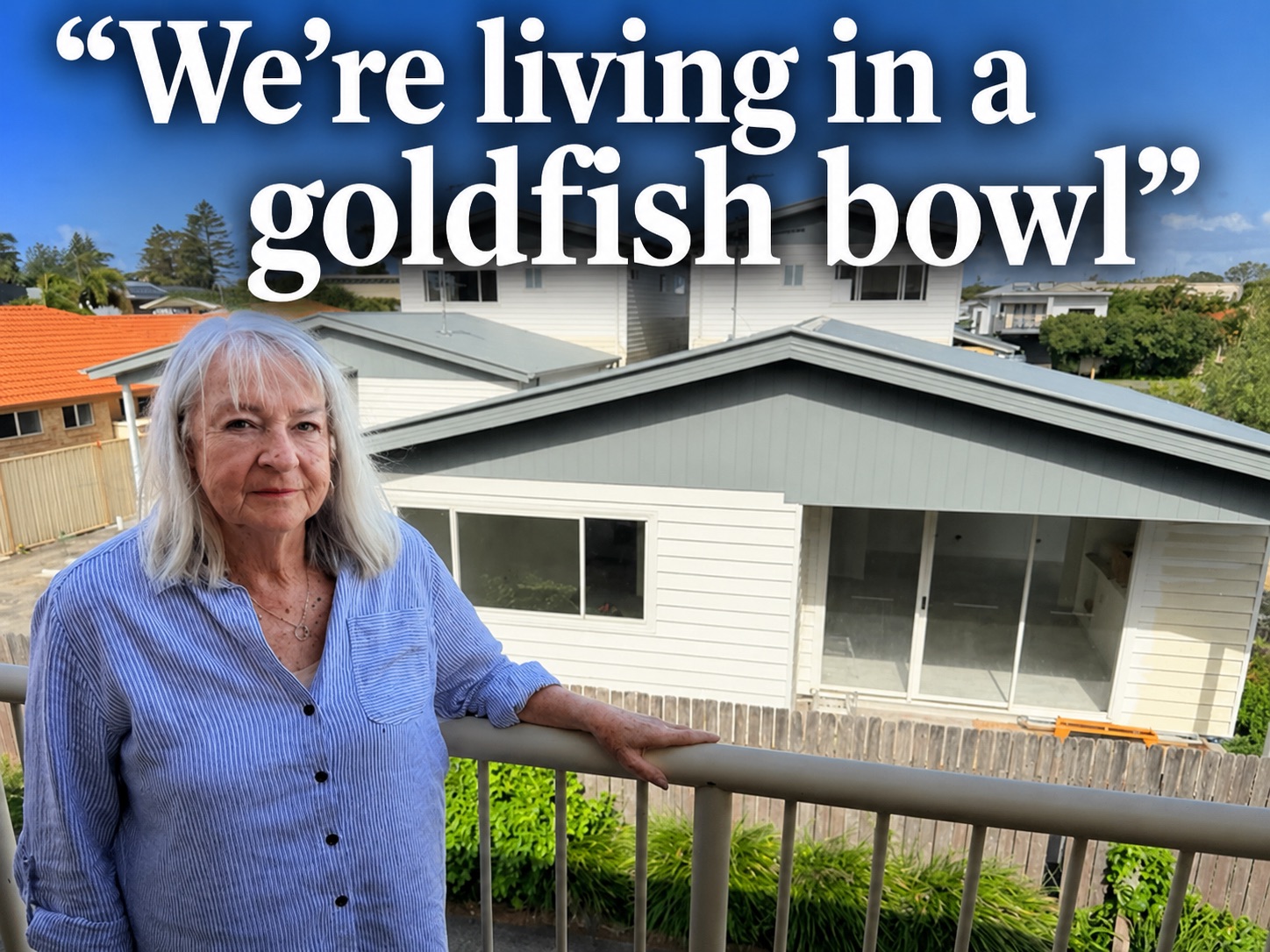
The Ballina Island resident says a new development under construction beside her Skinner Street property has transformed the way she lives in her own home.
A new balcony and large window now sit less than a metre from her boundary fence, directly overlooking her lounge room, bedroom, driveway and garage.
“We knew it was going to be close, but who would put a balcony there?” she said.
‘Living in a goldfish bowl’
Standing on her upstairs balcony (main image), Ms Packham can point directly into the neighbouring unit.
“It’s worse than a caravan park,” she said.
“At least the caravan parks are not facing each other.”
Ms Packham said she first raised concerns with Ballina Shire Council in November last year, shortly after work began on the project.
She said nearby residents had received notification of the proposal, but claimed the plans they saw did not fully convey the impact the finished development would have.
“All it had was an outline,” she said.
“It didn’t show the windows or the balcony.”
Despite repeated correspondence with council staff, councillors and senior management, Ms Packham said she felt residents had largely been left to fend for themselves.
Ballina Shire’s population is forecast to grow from about 48,000 residents today to more than 62,000 within two decades, with increased CBD and Ballina Island density seen as a priority for the council.
“I have been fobbed off over and over again,” she said.
“The person I spoke to in council when asked could we have a 2.4 metre fence stated council would not approve it because it would stop sunlight and airflow into the unit.
“Well what about us?”
The development highlights a growing tension playing out across Ballina Shire and other fast-growing coastal communities, where state planning reforms are increasingly encouraging urban infill and higher-density housing in existing residential areas.
Supporters say the changes are necessary to ease the housing crisis and prevent endless suburban sprawl onto farmland and environmentally sensitive land.
But critics argue the pendulum has swung too far, leaving existing residents with diminished privacy, overshadowing and a growing sense that local voices carry little weight once projects are approved.
Dream retirement under threat
Among them is Ballina Island resident Andrew Jeffs*, a retired solicitor who moved to the area with his wife three years ago seeking a quieter retirement lifestyle.
The couple bought what they believed would be their dream unit, drawn by sweeping views over North Creek and toward East Ballina.
But Mr Jeffs says those views — and much of the amenity they paid for — could soon disappear.
He recently became aware of plans by a neighbouring property owner to build higher on an adjoining site.
He fears the proposal could significantly impact both their outlook and the value of their home.
“We retired here for the lifestyle,” he said.
“You expect change in a town, but people also expect some fairness and some protection of basic amenity.”
Drawing on his legal background, Mr Jeffs spent months researching planning pathways, development approvals and appeal rights.
He believes many homeowners do not realise how limited their options can become once a project reaches certain stages.
What homeowners should do
- Check council DA notifications regularly, not just letters in the mailbox.
- Ask to view full plans, including elevations, balconies and window placements.
- Lodge objections early and in writing.
- Photograph existing views, privacy and sunlight before nearby work begins.
- Seek independent planning advice where possible.
- Understand that complying developments may have fewer appeal pathways.
- Talk with neighbours early, as combined objections can carry more weight.
He also argues there is a major imbalance between ordinary residents and developers navigating increasingly complex state planning rules.
“There needs to be an independent watchdog or advocacy body for homeowners,” he said.
“At the moment, most people have no idea where to turn.
“They can’t afford planning lawyers or expert consultants, and councils often say their hands are tied because developments comply with state policy.”
Mr Jeffs said many residents only discovered the true scale of nearby projects once construction was already underway.
He believes clearer notification rules and stronger visual modelling requirements are needed so people can properly understand what proposed buildings will look like from neighbouring homes.
The bigger planning battle
The debate comes as councils across NSW face increasing pressure from the state government to deliver more housing in existing urban areas.
Recent reforms have encouraged duplexes, townhouses, secondary dwellings and medium-density housing in suburbs previously dominated by detached homes.
On Ballina Island, where waterways, narrow streets and older homes create unique planning constraints, some residents fear the character of established neighbourhoods is rapidly changing.
Others argue higher density is inevitable in a growing coastal town where housing affordability has deteriorated sharply.
The challenge for councils is balancing that growth with privacy, sunlight, traffic, drainage and neighbourhood character.
In Tricia Packham’s case, the practical impact is immediate.
She says everyday life now feels exposed.
“You’re basically going to be living like in a goldfish bowl,” she said.
While frustrated by the process, she said she also worried similar situations were quietly emerging across Ballina.
“There needs to be some sort of privacy,” she said.
“We shouldn’t have to fight this hard just to enjoy our own home.”