
Country mayors vow to claw back cuts to emergency funding
Share This Story, Choose Your Platform!
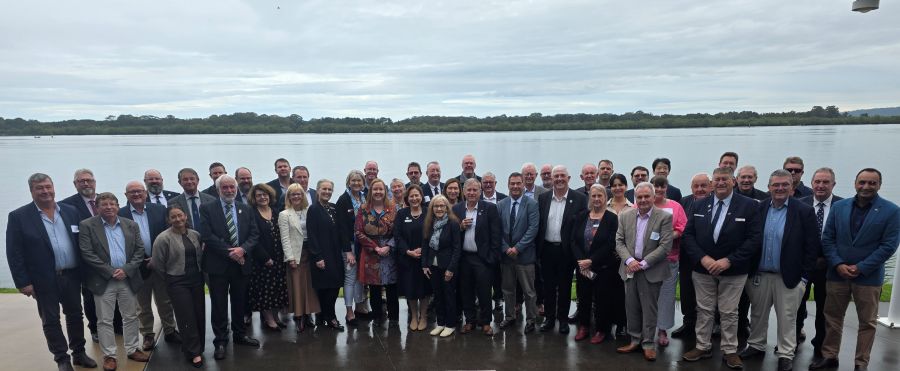
NSW country mayors meeting in Ballina have vowed to stop the federal government scaling back disaster recovery funding to the states.
NSW Country Mayor Association Acting Chair Russell Webb said regional shires will suffer if the federal government goes ahead with a plan to change the commonwealth-state split of disaster funding from 65/35 to 50/50.
The change in funding outlined in the Independent Review of Commonwealth Disaster Funding is estimated to cost NSW and Queensland $300 million a year, according to The Australian.
The 2022 floods caused an estimated $16 billion in damage.
“We will certainly support the state government in actually maintaining the funding from the federal government at a higher level,” Mr Webb said.
He says regional shires hit by floods and fires were already struggling to repair basic infrastructure such as roads and bridges, and that the disaster funding grant system was difficult to navigate.
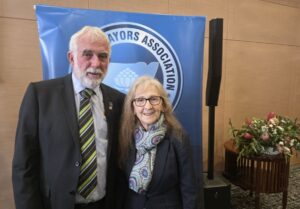
Russell Webb with Janelle Saffin
“The biggest problem for local government is that if we do try to fix those major problems ourselves and fund them through borrowings,” he said.
“And we then go and put the grant application in, and there’s no guarantee we will get the money back, and we’ll be caught short.”
Mr Webb also opposes the trigger for Commonwealth disaster recovery funding being raised from $240,000 per disaster to $2.7 million, meaning few regional shires would qualify for support.
Ballina’s Mayor Sharon Cadwallader put it very simply.
“The Federal Government has all the money, the state government has all the power, and local government has all the problems.”
The state’s country mayors were also briefed on disaster recovery funding by the new CEO of the NSW Reconstruction Authority, Kate Fitzgerald.
Ms Fitzgerald said Queensland was usually pointed to as Australia’s most disaster- prone state, but New South Wales’s disaster recovery programs are now equivalent in scale to Queensland’s.
“In the most recent federal budget, there was about $15 billion allocated over the forwards to the DRFA [Disaster Recovery Funding Arrangements] arrangements of which New South Wales has $8 billion of that and Queensland $6.3 billion of that,” she said.
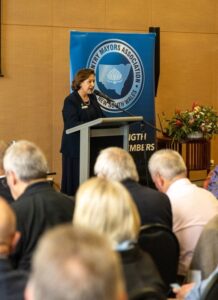
Sharon Cadwallader addresses the Country Mayors conference
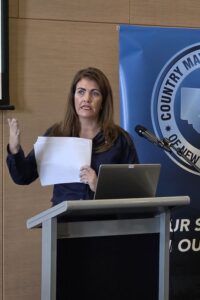
Kate Fitzgerald
Ms Fitzgerald pointed out that natural disasters were costing Australia about $11 billion in 2023/24, but the 2025 Independent Review of Commonwealth Disaster Funding forecast that this will rise to $40 billion by 2025.
Ms Saffin, who is also the minister for Northern NSW, said the states have until mid-August to respond to the federal government about disaster funding.
“I am acutely aware of the need to fight for some of that money to make sure we’re in an equitable, more than equitable position, because realistically the federal government has a little bit more money than us and they have more capacity to get money,” she said.
Queensland’s Disaster Recovery Minister Ann Leahy has told the ABC the state’s bridges will be left “half repaired” and its roads will “remain in ruins” under changes.
NSW National Leader Gurmesh Singh condemned the changes to disaster funding, given that the Commonwealth was benefiting from growing tax receipts.
“You can comfortably say from a bipartisan point of view that it hasn’t been a good job from the Albanese government on this,” he said.
Prime Minister Anthony Albanese said the review is about fast-tracking funding.
“It’s about making sure that we remove some of the red tape and bureaucracy. Previously, there wasn’t a system put in place. You had to have letters and exchanges and assessments taking place,” he said.
“What we’ve done is to move through in a full and fair way, 50-50 funding arrangement for every major event.”
Mr Albanese said that before his government was elected, there wasn’t a national emergency management agency in place.
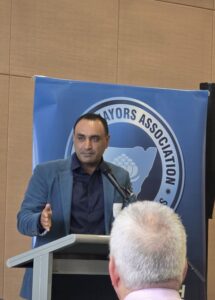
NSW National Leader Gurmesh Singh