


NAPLAN success: How one local school is changing the way children learn
Share This Story, Choose Your Platform!
To many parents, it might look like a return to the classroom they remember. Children are learning phonics, reading aloud together, practising handwriting, mastering maths facts and being taught by a teacher standing at the front of the room.
At St Joseph’s Primary School in Alstonville, however, educators say those techniques are not a step backwards. They are part of a modern, evidence-based approach to teaching that has produced the strongest NAPLAN results in the school’s history, with students performing above state and national averages across every Year 3 and Year 5 assessment for the first time. The success is now attracting attention from other schools, with educators visiting Alstonville to learn from the school’s approach.
Principal Kurt Challinor says the results are the product of a deliberate four-year focus on evidence-based teaching, regular assessment and early intervention, supported by a school culture that combines high expectations with strong pastoral care.
“NAPLAN is only one measure of student achievement, but it is a fairly important one,” Mr Challinor said.
“We’ve been working really intentionally over the last four years to improve our pedagogy by implementing evidence-informed practice.
“We’re really impressed with the students, and our teachers have been phenomenal. They’ve worked so hard and we’ve seen really sustained growth, particularly over the past two years.”
The improvement extends well beyond test scores.
Student attendance has climbed above 90 per cent, sick bay presentations have fallen by around 25 per cent and the school’s internal literacy data shows significant gains in reading proficiency since the improvement strategy began.
For Mr Challinor, who became principal in 2023 after leading secondary learning and teaching across the Diocese of Lismore Catholic Schools Office, the results demonstrate what can happen when teaching practices are guided by evidence rather than educational trends.
The science behind the success
Many of the classroom practices now being used at St Joseph’s would be instantly recognisable to parents and grandparents.
Students are taught phonics explicitly in the early years. They read aloud together. Handwriting remains an important classroom skill. Teachers model new concepts before students practise them independently, while mathematics lessons begin with exercises designed to build fluency with basic number facts.
What is NAPLAN and why do these results matter?
The National Assessment Program – Literacy and Numeracy (NAPLAN) is Australia’s annual assessment of students in Years 3, 5, 7 and 9. It measures student achievement in reading, writing, spelling, grammar and punctuation, and numeracy.
Rather than giving students a pass or fail grade, NAPLAN assesses whether they are Exceeding, Strong, Developing or Needs Additional Support against national proficiency standards.
This year’s results showed NSW students continue to perform above the national average, with encouraging improvements in spelling, grammar and numeracy. However, writing remains a concern across Australia, particularly in Years 5, 7 and 9. Education experts believe increased use of technology and less extended handwriting may be contributing to the decline, prompting calls for more pen-and-paper learning and even a return to handwritten NAPLAN writing tests.
Against that backdrop, St Joseph’s Primary School’s results stand out.
The Alstonville school has spent four years strengthening explicit teaching, phonics, handwriting, writing instruction and regular literacy assessment—many of the same evidence-based approaches now being promoted more broadly to lift student achievement.
While some might describe that as a return to “old-fashioned” teaching, Mr Challinor says the school’s approach is grounded in a growing body of international pedagogy research.
“It’s called the science of learning,” he said.
“The evidence is becoming really clear about what works.”
Central to the school’s approach is explicit instruction, where teachers clearly explain new concepts, model learning, regularly check students’ understanding and respond quickly whenever learning gaps emerge.
Rather than waiting for NAPLAN or end-of-year exams to reveal students who are struggling, teachers continually monitor progress throughout the year.
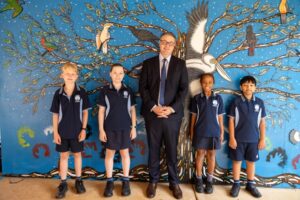
St Josephs Principal Kurt Challinor with Year 5 students. (L-R) Quinn McIlroy, Tess Jones, Andrea Gooding and Zareef Haque.
One of the key tools is DIBELS (Dynamic Indicators of Basic Early Literacy Skills), a series of short literacy assessments used across the Catholic Diocese of Lismore. Some assessments take little more than a minute, allowing teachers to identify learning gaps almost immediately and provide extra support before students fall behind.
“Some assessments are occurring every two weeks, so we know if kids are missing learning as we go,” Mr Challinor said.
“We can be really responsive and adaptive, come back and reteach that, or identify students who need additional reinforcement.”
The philosophy is summed up in one statement Mr Challinor often uses.
“You can’t Tier 2 your way out of a Tier 1 problem.”
In other words, schools cannot rely on intervention programs alone. The greatest gains come from ensuring every child receives excellent classroom teaching from the outset.
As classroom teaching has strengthened, fewer students have required intensive intervention, allowing specialist support to focus on those who genuinely need it.
Every child knows their next step
Writing has been another major focus of the school’s improvement strategy.
Every student has an individual writing goal based on their current level of achievement, whether that involves mastering punctuation or learning to write increasingly sophisticated sentences.
“If you can’t write a good sentence, then you’re really going to struggle writing a paragraph,” Mr Challinor said.
“So we’ve put a lot of work into teaching sentence construction explicitly.”
Mathematics has undergone a similar transformation.
Lessons begin with daily fluency activities designed to build automatic recall of number facts before students move on to more complex mathematical thinking.
The approach draws on research into cognitive load, which suggests students learn more effectively when fundamental skills become automatic rather than competing for working memory while solving more difficult problems.
Technology still has an important place in the classroom, but Mr Challinor says it is used where it genuinely enhances learning rather than replacing fundamental skills such as handwriting and reading.
“We want them to write neatly because there’s a strong connection between handwriting and learning. When students write by hand, they’re engaging more of the brain in ways that help with memory and understanding.”
More than just NAPLAN
Mr Challinor is quick to credit the entire school community for the transformation.
He praised assistant principals Kate Jones and Phil Crosby, learning support leader Anna Moloney and the teaching and support staff for embracing the school’s improvement journey.
“Our staff have been wonderful, and so have our parents,” he said.
“They’ve all been with us on that journey.”
Central to the school’s philosophy is its motto, “Growth Through Love”, combining high expectations in the classroom with a commitment to ensuring every child feels known, supported and able to thrive.
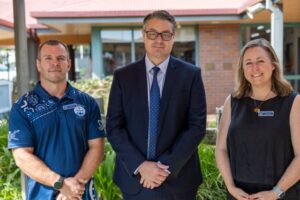
Kurt Challinor with Assistant Principals Phil Crosby and Kate Jones.
“As Catholic schools, we have a moral imperative to make sure our kids leave our schools really well educated, but that they also learn how to love one another,” Mr Challinor said.
St Joseph’s success is also attracting attention beyond the Plateau.
Diocese of Lismore Catholic Schools CEO Adam Spencer said the Alstonville school’s outstanding results reflected a broader improvement taking place across the Catholic education system.
“While our schools have always laid a strong foundation, our renewed focus on evidence-based practices and foundational literacy is showing remarkable early promise across the board,” Mr Spencer said.
“We are seeing strong upward growth across all Year 3 domains, alongside around one in five students reaching the ‘Exceeding’ benchmark in Year 5 and Year 7 Reading, with similar success in Year 9 Writing.
“These are proud milestones, and they are a direct reflection of the incredible hard work of our teachers, support staff and students every single day.”
Schools are requesting copies of St Joseph’s 80-page instructional “playbook”, while others are visiting Alstonville to observe the teaching model firsthand.
For Mr Challinor, however, the greatest measure of success is not a test score.
“It’s been a long journey,” he said.
“But when you see the confidence the students have now, and the way they’re learning, that’s what makes all the hard work worthwhile.”
Share This Story, Choose Your Platform!
One Comment
Comments are closed.



So pleased to read this.