

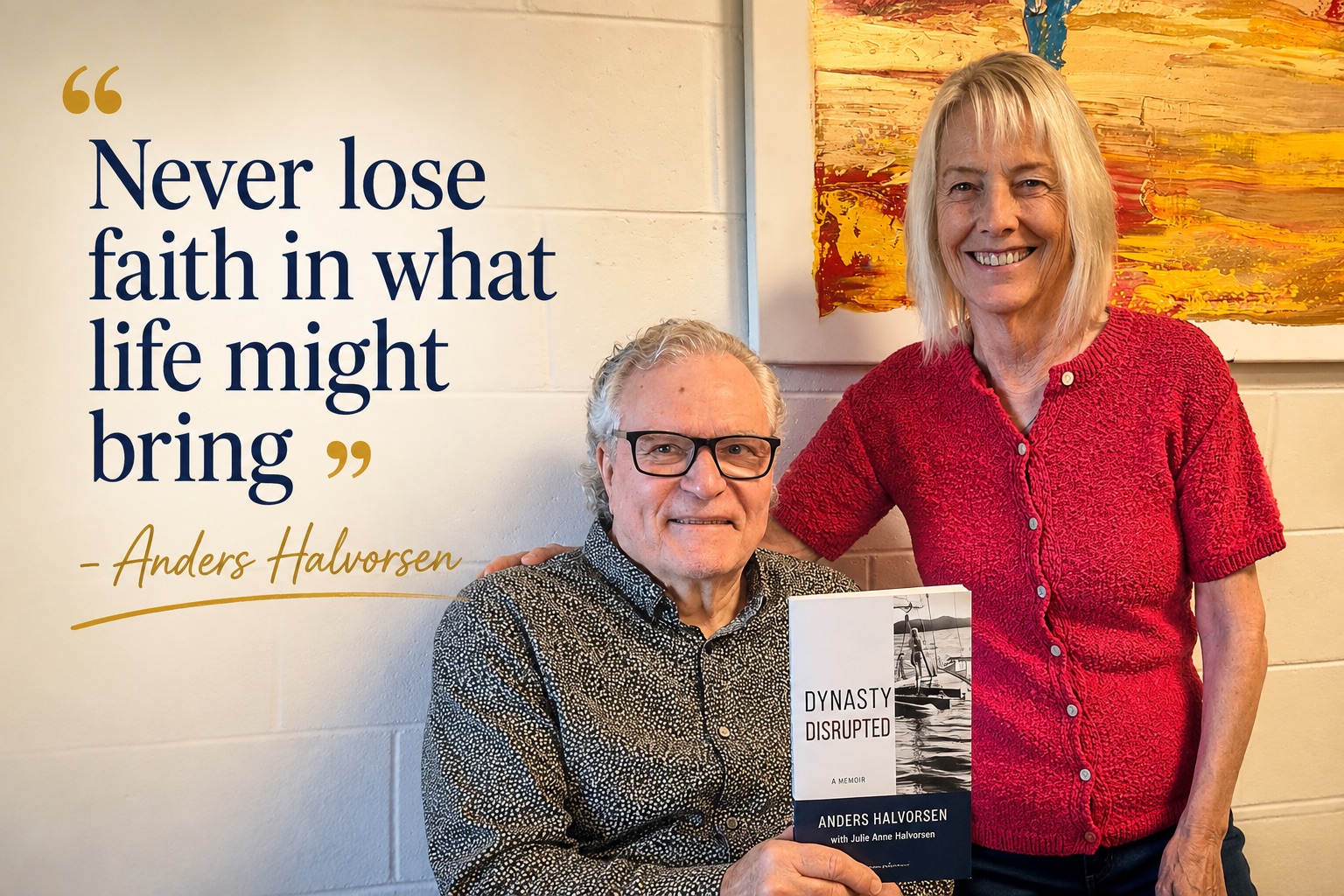
A broken spine, an uncertain future — and the life Anders Halvorsen built anyway
Share This Story, Choose Your Platform!
A devastating accident took away the future young Anders Halvorsen expected and left him facing a grim prognosis. More than half a century later, the Ballina OAM recipient, businessman, disability advocate and church founder has documented the extraordinary life that came instead.
Like many people in their senior years, Anders and Julie Anne Halvorsen decided it was time to put their life story on paper. But this is no ordinary memoir: Anders survived an accident few expected him to, outlived a grim prognosis by decades and, with Julie Anne, built the family they had been led to believe was virtually impossible.
Dynasty Disrupted is the story of how – and why – so much of what seemed certain has proved wrong.
A catastrophic motorcycle accident on a winding country road near Oberon on Good Friday in 1973 left Anders with a broken spine and no feeling below the chest while still in his early 20s, at a time when survival from such an injury was far less certain than it is today.
More than half a century later, Anders is 76 and believed to be among Australia’s longest-living people with paraplegia, having survived not only the original trauma but decades of potentially life-threatening complications associated with spinal cord injury.
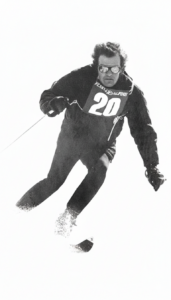
Anders Halvorsen on the ski slopes before the 1973 motorcycle accident that left him paraplegic. The Halvorsens were among the Norwegian expatriate families who helped pioneer skiing in the Snowy Mountains, and the photograph captures the active life Anders had known before everything changed.
He credits that longevity to several things: the pioneering medical care of spinal specialist Dr John Yeo, a considerable streak of Viking determination and Julie Anne, the young woman who chose to share a future with him when neither had any real idea what that future would involve.
But running through all of it has been Anders’ Christian faith. In the darkest period after the accident, it gave him something beyond the medical prognosis to hold onto — not a belief that God had caused what happened, or that everything would somehow become easy, but that something good and worthwhile could still emerge from circumstances he would never have chosen.
Their story is told in Dynasty Disrupted, a memoir which begins with Anders’ childhood among the boats, characters and traditions of the Halvorsen family before following the dramatically different life he and Julie Anne eventually built together.
A future nobody could predict
Perhaps one of the most remarkable decisions in the book belongs not to Anders, but to Julie Anne.
The pair had dated previously but were no longer a couple when Anders crashed his motorcycle. When they found their way back to each other after the accident, Julie Anne was just 21 and faced a decision few young women could have imagined.
Anders would never walk again. His life expectancy was uncertain and Julie Anne was told he might live another 15 or 20 years. Perhaps most significantly for a loving young Christian couple who might naturally have imagined raising a family together, there was little reason to believe they would ever be able to have children.
Julie Anne understood those stark predictions when she chose to marry him, but she could have had little understanding of what living with a spinal cord injury would actually mean across the decades ahead – or, for that matter, that there would be so many decades ahead.
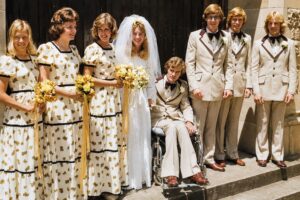
Anders and Julie Anne Halvorsen on their wedding day. Julie Anne married knowing Anders might have only another 15 or 20 years to live.
There was no NDIS, little of the disability support taken for granted today, and a world of workplaces, shops, public buildings, accommodation and even bathrooms designed with little or no thought for somebody in a wheelchair.
Nor could either of them have imagined how completely some of those early expectations would eventually be overturned.
They became parents to Lars, Annaliese and Luke, raised their family in a marriage that has now lasted more than half a century and today have nine grandchildren, who are among the great joys of their lives.
Julie Anne recalled being told at 21 that Anders might have another 15 or 20 years. Those years eventually came and went, and Anders remained remarkably healthy.
“He didn’t look like he was going anywhere,” she said with a laugh.
They gradually realised that rather than preparing for a shortened life together, they might actually grow old together.
The dynasty that was disrupted
The title Dynasty Disrupted reflects the very different future Anders might once have expected.
His grandfather was legendary Norwegian-born boatbuilder Lars Halvorsen, who brought his young family to Australia and established a name that became synonymous with some of the finest boats built last century.
Anders’ father Magnus became one of the principals of Lars Halvorsen Sons and was closely involved in Australian sailing, including the Sydney to Hobart Yacht Race and the building of Gretel, Australia’s first challenger for the America’s Cup in 1962.
Growing up among boats, boatbuilders and sailors during the 1950s and ’60s, Anders appeared destined to follow in the family wake.
Then came the motorcycle accident.
The damage to his spine was devastating, although the full physical extent of it would not become apparent to Anders and Julie Anne until medical imaging technology decades later allowed them to see it with extraordinary clarity.
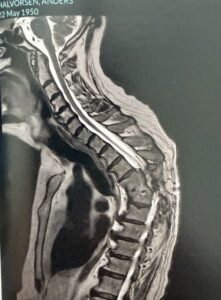
The extraordinary extent of Anders spinal injury, revealed by an MRI decades after his 1973 motorcycle accident.
An MRI taken about a decade ago revealed an injury so confronting that Anders says a highly experienced medical professional, when shown the image without being told whose it was, concluded it represented death from spinal cord injury.
It was Anders’ spine.
By then, the man whose injury appeared incompatible with survival had already been living with it for more than four decades.
The doctor Anders credits with saving him
Among those Anders credits most strongly for that survival is Dr John Yeo, a pioneering Australian spinal specialist who became head of the spinal injuries service at Sydney’s Royal North Shore Hospital.
At a time when the treatment and rehabilitation of people with severe spinal injuries was still developing, Yeo was part of a generation changing expectations about what might be possible after such an injury.
Anders remembers him not simply as the doctor who treated him, but as somebody determined that his patients should have a life beyond the hospital.
Sport became part of that rehabilitation. Patients were encouraged to try basketball, table tennis, field events and archery, with Anders discovering an unexpected talent for the latter.
“He’d take us down and get us to try things like basketball or archery or shot put or discus or table tennis,” Anders recalled.
For a young man whose first thought had been that he might spend the rest of his life sitting on a back verandah with a rug over his knees, it helped open an entirely different possibility.
Medicine helped save Anders’ life, but his Christian faith helped shape what he decided to do with it. He drew strength from the biblical teaching that God can bring good from circumstances that are not themselves good.
Anders does not believe that means God caused his accident. Rather, he came to believe God had allowed it, and that his task was not to spend his life asking why it had happened, but to discover what purpose might still lie ahead.
He decided to find out what life he could still build.
Starting again in Dubbo
That determination took Anders away from Sydney and the security of his well-known family to Dubbo, where he became involved in a motor rewinding business and began establishing a career.
Despite the perception that being a Halvorsen might have guaranteed a privileged life, the early years for Anders and Julie Anne were anything but easy.
Before Anders arrived, his business partner took a wheelchair to the building they had bought to see how well he could get around. Surprisingly, it had no step at the entrance, a wider-than-normal hallway and enough room to manoeuvre a wheelchair. It even had evaporative air-conditioning — particularly important because Anders’ injury affected his ability to regulate body temperature.
There were less encouraging discoveries. The building had no bathroom, no running water and mice.
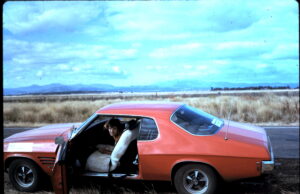
A young Anders with his specially adapted Monaro during the years when he was building a new life and career.
Money was tight, accessibility was rudimentary and specialist medical care was a long way away. They were establishing a business, a marriage and, against the expectations they had been given, a young family in a regional city where there was no elaborate support system waiting to catch them when things went wrong.
In some ways there was an echo of Anders’ grandfather Lars, who had left Norway and brought his young family to Sydney to begin again and create the Halvorsen boatbuilding dynasty.
Anders had been expected to inherit part of that world. Instead, he had to build something of his own.
There were episodes that today seem almost inconceivable, including becoming bogged in a paddock outside Dubbo during winter and having to manoeuvre himself from his car into his wheelchair, through the mud and eventually towards the highway in search of help.
There was no mobile phone in his pocket to summon assistance. Mobile phones were still years away, so when Anders found himself stranded – as he did in this and other predicaments during those early years – solving the problem himself was often the only option.
He does not tell such stories as heroic feats. There was simply no alternative, and for Anders the danger was compounded by his inability to properly regulate his body temperature, making prolonged exposure to cold potentially dangerous.
“I didn’t have any choice,” he said. “Otherwise I was going to freeze to death in the paddock.”
That necessity, Anders believes, helped build a particular resilience among his generation of people with spinal injuries because so many everyday problems simply had to be solved for themselves.
From a stranger in a wheelchair to a Ballina ally
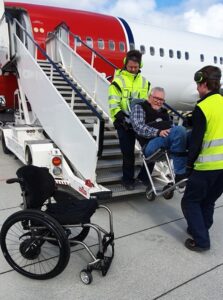
Anders being assisted from a plane in Norway in 2019, when he and Julie Anne were finally able to visit his family’s homeland together for the first time.
Anders has another story that illustrates just how unfamiliar disability was to many Australians of his generation -including Anders himself.
Just weeks before his accident, Anders attended his sister Jan’s engagement party at St Ives, where another guest arrived in a wheelchair.
Anders had never met anyone in a wheelchair before and admits it took him about three hours to summon the courage simply to walk over and say hello.
The man was Phil Silver.
Six weeks later, with Anders himself lying in hospital following his accident, Silver became the first person using a wheelchair to visit him.
Their paths would cross again years later in Ballina, where Silver became one of the town’s best-known civic figures and served as mayor, while both men became advocates for improving the lives and independence of people with disability.
For Anders, there was an extraordinary symmetry in finding himself working alongside the man he had once been uncertain how to approach, lobbying for a community in which a wheelchair would no longer be something unfamiliar or confronting.
Building a life in Ballina
Anders and Julie Anne eventually made Ballina home, moving into the house where they still live 45 years later.
Here Anders became increasingly involved in advocating for people with disability, at a time when even the concept of accessibility was poorly understood.
He remembers joining with Phil Silver and a few other wheelchair users in Ballina pushing for better access to local businesses, eventually persuading council representatives to try navigating the town themselves using wheelchairs and a blindfold.
The exercise quickly demonstrated how difficult supposedly ordinary tasks could be.
Anders later served in senior roles with disability organisations including ParaQuad NSW, now Forward Ability Support, and was involved in the long campaign by disability organisations that helped build momentum for what ultimately became the National Disability Insurance Scheme.
He remains a life member of Forward Ability Support and, while strongly supportive of the principle that people with significant disabilities should receive the assistance they need, believes the NDIS still requires substantial reform to ensure resources reach those with the greatest needs.
His decades of advocacy and community involvement were recognised with the Medal of the Order of Australia in 2021.
Yet Anders is quick to point out that, for all the improvements since the 1970s, accessibility remains imperfect.
Air travel can still involve lengthy negotiations over his wheelchair equipment, while supposedly accessible hotel rooms can prove anything but accessible once he arrives.
The difference now is that society at least recognises there is a problem.
A faith that became a life of service
Faith was never something Anders and Julie Anne confined to getting through the difficult times. As their family grew and their life became established in Ballina, it increasingly found expression in what they could do for other people.
With their own children growing up, they wanted a contemporary Bible-believing church where younger people could connect with Christianity in a way they felt was relevant to their lives.
That brought them together with Jeff and Carolyn Frankham, who had returned to the region after years in Queensland.
The conversations that ultimately led to C3 Church Ballina began in the Halvorsens’ home.
“The church was actually started in this room,” Anders said during our interview, looking around the room where he and Julie Anne still live.
For the couple, helping establish the church remains one of the achievements of which they are most proud, not simply because an organisation was created but because of the community that grew around it.
Their faith has also helped shape a life of giving, including involvement with child sponsorship in several countries and support for young people affected by conflict in Uganda.
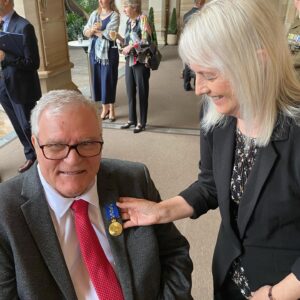
Anders with Julie Anne after receiving the Medal of the Order of Australia in 2021, recognising his service to people with disability and the community.
For Anders, faith did not mean believing the accident itself was good or pretending the difficulties that followed did not exist.
Instead, it gave him confidence that something worthwhile could still emerge from circumstances he would never have chosen.
Writing Dynasty Disrupted
The idea of recording their story had been around for years, with people who heard parts of Anders and Julie Anne’s life regularly telling them they should write a book.
Eventually they decided the story needed to be told their own way.
Julie Anne took on much of the writing, even the passages in Anders’ voice after more than half a century of hearing him tell his stories.
An extraordinary resource was Anders’ lifelong habit of keeping diaries, something he began after watching his father do the same.
When part of an early manuscript was accidentally lost, Julie Anne went back through boxes of those diaries, reading page after page to reconstruct events and rediscover details they’d forgotten.
The result is a substantial memoir that is part Halvorsen family history, part love story and part account of what it means to live with a severe disability today and through an era of enormous social and medical change.
It also contains plenty of humour, adventures that did not go according to plan, travel, family life and the inevitable difficulties and joys of two people spending more than half a century together.
One Ballina chapter barely told
For all the ground the book covers, there is one episode Anders chose not to revisit in any great detail, although it is one that some long-term Ballina and Northern Rivers residents will remember.
About two decades ago, Anders was an executive director and chief financial officer of Permo-Drive, a Ballina technology company developing a regenerative drive system capable of capturing braking energy from heavy vehicles, storing it and using that energy later.
The technology attracted considerable attention and investment, including from people across the Northern Rivers, and at one stage its prospects appeared enormous.
Anders says the company attracted serious interest from the US military, which saw potential both to reduce fuel consumption and to move military vehicles short distances without starting their engines and producing a heat signature.
His own involvement, however, ended abruptly when he was removed from the company after being accused internally of wrongdoing associated with a $700,000 research and development grant.
Anders emphatically denies acting improperly and says he subsequently learned that the company reapplied for the grant.
The accusation was particularly painful because Anders had, as a Christian, publicly championed ethical conduct in his business dealings, making any suggestion that he had behaved dishonestly contrary to principles around which he had built his life.
Rather than embark on what could have become a prolonged fight, Anders chose to walk away.
Permo-Drive continued without him and eventually collapsed, leaving investors, including people across the region, out of pocket.
More than two decades later, Anders says he is at peace about what happened to him personally, but still feels deeply for those who invested in the venture and lost money.
Nor has he lost faith in the invention itself. He remains convinced the technology had genuine potential and believes that, under the right stewardship, it could have delivered on much of its promise.
Perhaps it says something about the purpose Anders and Julie Anne had in writing Dynasty Disrupted that this is not a story they chose to dwell upon.
The book is not an exercise in settling old scores, but in remembering a life.
Two railway lines
Anders has a simple way of describing that life.
He sees blessings and troubles running alongside one another, “like railway lines”, neither cancelling out the other.
There have certainly been troubles: the accident, medical complications, financial uncertainty, inaccessible buildings, business disappointments and the physical reality that, after more than half a century propelling himself through life with his upper body, age inevitably brings new challenges.
Just days before our interview came a reminder.
While transferring from his wheelchair to bed, Anders suddenly found his left arm extremely painful and barely able to move or straighten. Julie Anne had to help him undress and get into bed.
Through the night she wondered what it would mean if the arm did not recover. Anders has relied on the strength of his arms and shoulders for his mobility and independence for more than half a century, and a problem that might be an inconvenience for somebody else could potentially change almost every aspect of his life.
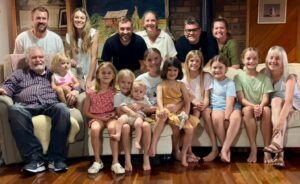
The future Anders and Julie Anne Halvorsen were once given little reason to believe would be possible: surrounded by their family, including their three children and nine grandchildren.
By morning it had improved.
But after 53 years of Anders defying expectations, it was another reminder that circumstances can still change quickly.
Yet alongside the troubles have run Julie Anne, their children and grandchildren, a Christian faith that has remained central to their lives, friendships, work, travel, community service and a life far longer and richer than either could have imagined when they contemplated marriage in their early 20s.
Even today, Anders does not spend much time wondering why he has survived for so long, although medical professionals increasingly do.
He has never suffered the serious pressure sores that can cause enormous problems for people with paraplegia, something he attributes partly to looking after himself and partly, with typical Halvorsen humour, to being blessed with “good Norwegian skin”.
For both of them, it is another reason to appreciate each day as it comes.
Dynasty Disrupted may have begun as an attempt by a couple in their senior years to leave their children and grandchildren a record of where they came from and what happened along the way.
What emerged is the story of the life Anders Halvorsen might have been expected to live — and the very different one he and Julie Anne built instead.
Dynasty Disrupted is available through Amazon and at dynastydisrupted.com.
Disclosure: The author, Rod Bruem, is a great-grandson of Lars Halvorsen and a second cousin of Anders Halvorsen.
Share This Story, Choose Your Platform!
2 Comments
Comments are closed.

Wow, what a wonderful and heartfelt story of how an unfortunate twist of fate can produce strength and resilience in someone like Anders. Together with the strength of an obviously loving and supportive relationship with Julie Anne.
The full family photograph is so warm and loving that many of us aspire to, but never reach, and yet with no comparable setbacks.
Thank you so much for bringing this epic story to us of a family simply living their life, remarkable as it has been.
Thanks for sharing such a wonderful story. I would have expected the MRI to show perhaps just a small break, with lots of “nuts and bolts” trying to keep everything together. It’s a cliché, but “That’s gotta hurt!”