

Why three people are pinning their hopes on a global medical breakthrough unfolding on our doorstep
Share This Story, Choose Your Platform!
As a world-first clinical trial prepares to begin on the Gold Coast, three people living with spinal injuries — two from Ballina and one from just over the border — are daring to believe movement might one day return.
When Mick Chisholm was thrown from his motocross bike and into a deep washout eight years ago, he knew instantly that something was terribly wrong. His legs would not respond. His two young children witnessed the accident and started calling for him to get up, but he could not move. That single moment on a Queensland changed everything, and the Gold Coast tradesman feared he’d never walk again.
Now 48, Mick lives only a few kilometres from where researchers at Griffith University and surgeons at Gold Coast University Hospital are preparing to attempt something never tried before in humans: repairing the spinal cord using olfactory nerve cells taken from high inside a person’s nasal cavity. The idea is to bridge the damaged section of the spine and help new nerve connections grow. The wonder of nasal cells is they’re unique in the human body in their ability to regenerate and repair. The hope — cautiously, scientifically, but undeniably — is that some people with paralysis may recover meaningful movement.
Mick wants to be one of the first. So much so, he jokes:
“I applied seven times… just to make sure they got my name.”
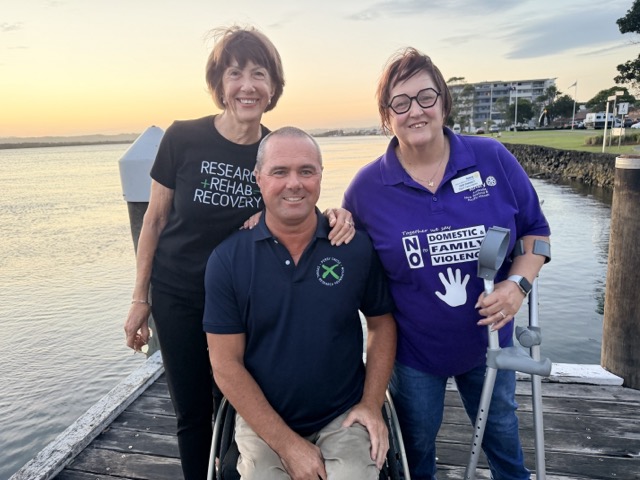
He travelled south last week to speak at Ballina on Richmond Rotary Club, where two Northern Rivers women who know exactly what life with spinal injury feels like listened closely and nodded along.
The breakthrough on our doorstep
Local Rotary identity Debbie Pawsey knows what it means to fight for every step.
A fall in 2016 left her unable to bear weight and she underwent surgery. When she came to, she immediately sensed, something was wrong.
“I awoke from that with every red flag for Cauda Equina, but it was not picked up and therefore the emergency surgery to correct this was not undertaken,” Debbie said.
The prognosis she was given was bleak.
“They did not have much faith that I would walk again and bluntly told us so.”
Cauda equina syndrome is a rare but urgent medical emergency that can cause permanent incontinence, sensory loss and severe leg weakness. Debbie had to face all of it.
And yet, she refused to give up.
“Five and a half weeks later, I was walking with a gait frame,” she said.
Through about 18 months of outpatient rehabilitation, Debbie slowly regained mobility.
“I managed to ambulate with forearm crutches,” she said. Today she still lives with significant impairment, but she stands as a determined voice for the research that may change outcomes for others.
Alongside her at Rotary sat Trina Farren-Price, who suffered traumatic spinal damage during a freak accident in the Sydney to Hobart yacht race in 1975 when a powerful wave threw her heavily and crushed vertebrae in her spine. Trina still lives with the fallout. She also lives with a fierce determination that, if hope exists, Ballina should not sit back and watch the science unfold elsewhere.
It is why she has become one of the region’s strongest supporters of the Perry Cross Spinal Research Foundation, and why she invited Mick to speak.
Trina told the room it is extraordinary that a potential global breakthrough is unfolding just over the border.
“It’s incredible. This is happening on our doorstep — only an hour or so up the road. What’s happening at the Foundation and the university, in conjunction with the hospital, is amazing. And it is worldwide news.”

PICTURED LEFT: The tiny speck of spinal damage that put Mick Chisholm in a wheelchair– doctors have created this exact replica of his spine to assess the possible task ahead. If he’s chosen to be part of the trial, they will place the cultured nasal cells on top of that small speck to help it rebuild and repair. The process has already worked in trial with mice.
Main Image: United for a Cure: Trina Farren-Price, Mick Chisholm and Debbie Pawsey
Hopes, reality and what comes next
The clinical trial — the first of its kind in the world — will involve 30 participants, including a smaller placebo group. Twenty people will undergo surgery to transplant a lab-grown nerve bridge developed from their own olfactory cells. Rehabilitation will be intense: six days a week, four hours a day, for about a year.
For many, the possibility of standing, balancing, or even taking a few steps is worth everything
As Mick puts it: “I don’t need to run on a beach again. I just want to stand up and pee in the bathroom, and have a shower standing up. Things most people take for granted.”
There are an estimated 20,800 Australians living with a traumatic spinal cord injury. On average, one person every day sustains such an injury. Families learn a new vocabulary of equipment, infections, pressure injuries and exhaustion. The annual economic cost is estimated at more than $3.5 billion.
“It doesn’t just affect the people who are injured,” Mick said. “It affects the entire family. My parents still haven’t recovered from it.”
Rotary members asked how the Northern Rivers could help. Trina said she can arrange lab tours so locals can see the work themselves. Mick encouraged support for the Foundation’s annual SIP Week awareness effort, in which people drink through a straw for seven days to better understand life with impaired hand function.
And then the meeting ended the way community gatherings often do in this region: with quiet reflections, a few tears, and the shared understanding that Ballina has a stake in what happens next.
There is no promise that this trial will restore the ability to walk. There is, however, hope — and for Mick, Debbie and Trina, hope is not a soft word. It is a discipline, a commitment, and now, for the first time in a very long time, a possibility.
Learn more
More information about the Perry Cross Spinal Research Foundation and the world-first clinical trial is available at:
https://www.pcsrf.org.au/
Share This Story, Choose Your Platform!
One Comment
Comments are closed.


Wishing Mick all the best for regaining mobility.