

New national laws are coming into effect, but no major changes for NSW over-75’s
A low-speed crash at a service station in Alstonville on Friday has become the third high-profile incident involving a senior driver in Ballina Shire, renewing questions about road safety and driver fitness.

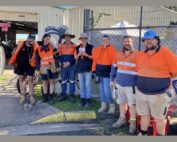
Above: Bystanders come to the aid of the 89 year old driver involved in the incident at Alstonville on Friday (Source: NBN News)
Main Image: The car inside Coles in 2023 (source: Facebook)
Just before 10am, a car driven by an 89-year-old woman collided at low speed with a fence at the Ampol service station on Main Street, Alstonville, adjoining the Options Café.
NBN News reported the impact forced diners to flee from their tables as the fence collapsed.
Ambulance paramedics treated two people at the scene, but no one was taken to hospital.
Police are continuing their inquiries.
Three incidents, similar settings
While no one was seriously injured in Alstonville, the incident follows two similar crashes involving senior drivers in Ballina Shire in recent years, all occurring during local, daytime driving in built-up areas.
The most serious occurred in September 2023, when a car driven by a woman in her 70s accelerated through the front entrance of the Coles supermarket in Ballina.
Two people were hospitalised following that crash, which unfolded inside a busy retail environment and caused extensive damage.
More recently, a hatchback driven by an 84-year-old woman crashed into the façade of the BCU Bank on River Street, Ballina last October.
No one was physically injured, but it was described at the time as another lucky escape, with no pedestrians on the footpath when the car struck the building.
The extensive damage forced the bank branch to close for several weeks while repairs were carried out.
Ballina News Daily is not aware of the medical or mechanical factors involved in any of the crashes and does not suggest that the drivers were necessarily at fault.
National rules, but no NSW change
The renewed local focus comes as new national driver-licensing rules begin taking effect this year, tightening requirements for drivers aged 75 and over in several states.
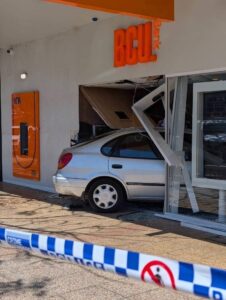
Lucky escape: the car crash on River St on October 1 2025
However, the changes are not expected to alter licensing conditions in New South Wales.
NSW already operates one of the most structured older-driver frameworks in the country, with increasing reliance on medical fitness and functional ability, rather than age alone.
Drivers aged 70 to 74 face no mandatory testing unless recommended by a doctor.
From 75, annual medical assessments apply, with additional on-road assessments applying for those over 85 every two years.
In effect, the national reforms largely see other states more closely align with stricter rules already in place in NSW and Queensland. Drivers north of the border are also required to carry their medical assessment with them.
“GP sign-off isn’t always independent”
But a regular Ballina visitor, Garry, said the real challenge is not the written rules, but the human judgement involved in applying them.
Garry told Ballina News Daily he was next-of-kin for his elderly uncle, aged in his mid-80s, and felt uneasy that annual medical sign-off can depend heavily on a long-standing relationship between patient and doctor.
“The requirement for GP sign-off isn’t sufficiently independent,” Garry said.
“The independent road driving test applies only to those over 85 and only every two years. A lot can happen in the health of an aged person in the space of two years.
“In my uncle’s case, the doctor and patient have known each other for decades. They see each other regularly. They’re essentially friends.”
Garry said the doctor was also of senior years and sympathetic to his uncle’s desire to remain independent.
“The doctor is very sympathetic to my uncle needing to stay independent,” he said.
He stressed the issue was not age alone.
“There are drivers in their 90s who are still fit and capable,” Garry said.
“Yet there are drivers in their 70s with complex medical conditions who perhaps are not.”
Restricted licences, but local driving still risky
Garry also questioned whether restricted licences, which allow local, daytime driving, meaningfully reduce risk.
“All three of the high-profile crashes in Ballina Shire happened during what would be classed as local daytime driving,” he said.
“That shows those restrictions don’t necessarily remove the danger. They just narrow where it happens.”
He believes doctors should be encouraged to apply the system more firmly.
“There is so much authority and discretion put in the hands of GPs, who in most cases would have no idea of what their patient is actually performing like behind the wheel of a car,” Garry said.
“They really need to be encouraged to exercise that authority with responsibility, and be tougher when it comes to signing off.”
Are existing restrictions on senior drivers sufficient, or are they too strict already? Please leave your thoughts in the comments below>