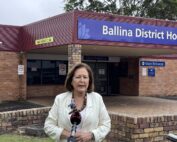


Minister rejects ‘bombshell’ tag as flood recovery fallout deepens
Share This Story, Choose Your Platform!
NSW Recovery Minister Janelle Saffin has rejected claims a damning Auditor-General’s report into the state’s flood recovery response is a “bombshell” or indicated absolute failures.
In an interview on ABC North Coast, Ms Saffin argued many of the problems identified were already well known locally and lessons had now been learned for future disasters.
The report found the state’s $980 million flood recovery response was badly planned, heavily delayed and had failed to deliver a single housing lot under the flagship Resilient Lands Program almost four years after the 2022 disaster.
But Ms Saffin said the failures needed to be viewed in the context of an unprecedented catastrophe and a recovery system that was effectively being built on the run.
“No public policy framework”
The minister said the original Northern Rivers Reconstruction Corporation had launched programs without an established public policy framework, forcing governments and agencies to adjust the schemes as they progressed.
“There had never been a programme done like this before in Australia at scale,” Ms Saffin said.
She acknowledged the recovery process had become bogged down in bureaucracy and red tape, but argued major improvements had since been made, including appeals processes and greater flexibility for flood victims.
Ms Saffin also stressed the government and Reconstruction Authority had accepted all five recommendations from the Auditor-General and said work on many of those reforms had already begun before the report was released.
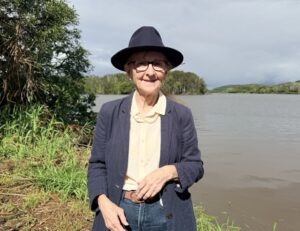
Janelle Saffin
She defended the spending of the nearly $1 billion recovery package, saying large amounts had gone into buybacks and emergency accommodation, including pod villages and temporary housing.
While critics have labelled the response a disaster, the minister argued thousands of residents had now been moved out of high-risk flood zones.
“There’s a lot of people who are out of harm’s way, out of the flood,” she said.
Ms Saffin also admitted governments across Australia had been poorly prepared for disasters of this scale.
“We weren’t prepared,” she said.
Queensland model debate

One of the homes being relocated under the buy-back (Photo: Nine NBN News)
Critics have long argued governments should have adopted proven flood recovery models already used after disasters in Brisbane and Grantham in Queensland.
However, Ms Saffin said the Northern Rivers disaster was vastly larger and more complex, stretching across multiple local government areas and involving thousands of damaged properties.
She said expertise had been brought in from Queensland, including people involved in the Grantham recovery, but the Northern Rivers response was effectively being built while the disaster was still unfolding.
Ms Saffin said the recovery effort had gone through several incarnations — from Resilience NSW, to the Northern Rivers Reconstruction Corporation, and finally the NSW Reconstruction Authority — with each restructure helping refine the model.
She argued that while mistakes had clearly been made, the current structure was now better positioned to deal with future disasters, resilience planning and mitigation work.
FitzGerald accepts responsibility
Earlier, NSW Reconstruction Authority chief executive Kate FitzGerald publicly accepted responsibility for the findings of the audit, saying the report reflected frustrations communities had been expressing for years.
“I take full responsibility for the outcomes of the audit report and its findings and recommendations,” Ms FitzGerald said in an interview with the ABC’s Hannah Ross.
She acknowledged the recovery programs had repeatedly changed direction over four years and said rebuilding trust with communities would now be critical.
Ms FitzGerald said the Reconstruction Authority expected land sales at the Mount Pleasant site in Goonellabah within weeks and remained focused on delivering almost 1,000 buybacks and hundreds of resilient housing upgrades.

Kate FitzGerald (Photo: Nine NBN News)
The Auditor-General’s report triggered strong public reaction across the Northern Rivers, with some residents describing the process as chaotic, confusing and exhausting.
One Meerschaum Vale resident described repeatedly trying to offer suitable land for relocated homes, only to face missed appointments and years of inaction.
Federal Member for Page Kevin Hogan said the audit confirmed what many flood survivors had been saying for years.
“Our community has been left behind with failed flood recovery efforts,” Mr Hogan said.
The Nationals MP said it was unacceptable the Resilient Lands Program had still failed to deliver a single home or housing lot.
“It will be more than five years since the floods before one home is ready to move into. That is simply not good enough,” he said.
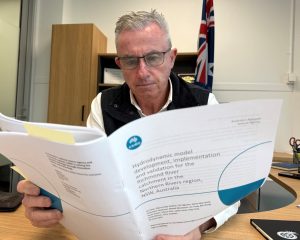
Kevin Hogan MP with the CSIRO’s 2022 flood hydrodynamic modelling report.
Main image: the full extent of flooding on March 3 2022 as modelled by the CSIRO.
Mr Hogan also argued the focus should now shift more heavily toward flood mitigation works rather than relying mainly on relocation schemes.
“The strategy of removing people from the floodplain has failed. The focus now needs to shift to flood mitigation,” he said.
Despite the criticism, Ms Saffin insisted the Northern Rivers recovery had produced important lessons that would shape future disaster responses across NSW.
“The better preparation, the better response, the better rebuild, and the better recovery,” she said.