

COMMENT: Bluesfest’s collapse is a loss for the region — but the warning signs were there years ago
Share This Story, Choose Your Platform!
The collapse of Bluesfest Byron Bay is a sad moment for the Northern Rivers and for Australia’s live music industry.
For more than three decades, it brought world-class artists to our doorstep, filled accommodation, and helped define our region as a cultural destination.
That contribution should not be forgotten.
But there is also a human cost to what is now unfolding.
Thousands of ticket holders may never see a refund. Suppliers, contractors and small businesses are likely to be left out of pocket. For many, the end of Bluesfest is not just symbolic — it is financial.
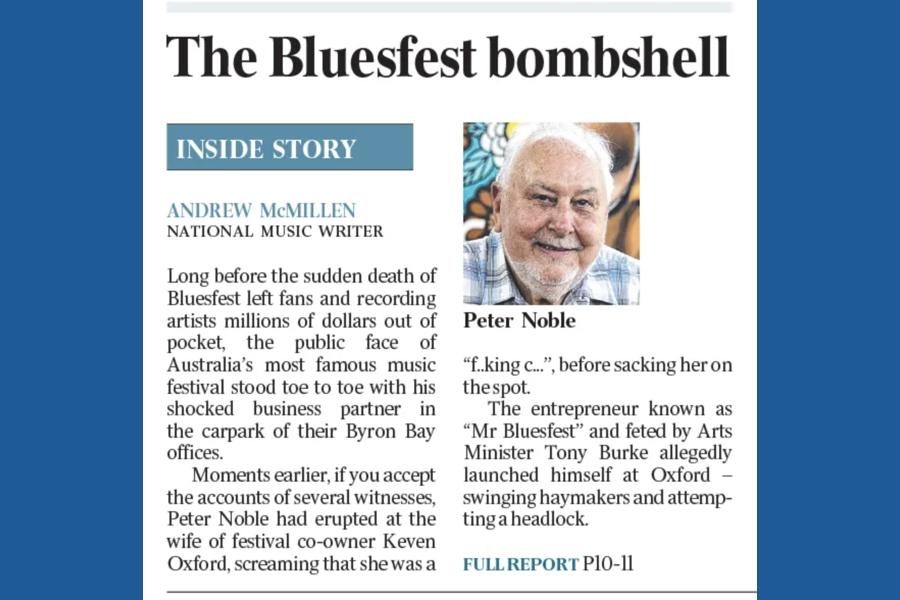
Today, the story has escalated to the national stage, with a front page investigation (main image) in The Australian by national music writer Andrew McMillen placing festival founder Peter Noble under intense scrutiny.
For years, Mr Noble has been widely celebrated by politicians and the media for his role in building one of Australia’s most successful music festivals — a figure credited with bringing international acts and significant economic benefit to Byron and surrounds.
Mr Noble, a Lennox Head resident, has long been a central figure in the region’s cultural and economic story.
The report draws on interviews with more than 20 former staff and outlines a series of allegations about workplace behaviour spanning decades. It also details the festival’s financial position, including debts in the millions, and raises concerns about whether ticket holders will be refunded.
Mr Noble, through his lawyers, has denied wrongdoing and says the reporting is unfair.
The allegations are serious, and they will be tested in their own time.
But for me, parts of what is now being reported feel uncomfortably familiar.
Back in 2021, when I was hosting the breakfast show on Ballina’s Paradise FM, I witnessed an incident that has stayed with me.
In the lead-up to Easter, with rain forecast, I made a light on-air comment that things weren’t looking great for Bluesfest.
Moments after, Mr Noble called the station and took issue with it — directing his frustration toward one of our elderly volunteers.
She was left in tears after the call.
I addressed it on air, making it clear that if there was a problem with something I had said, it should be taken up with me — not someone answering the phone.
In the days that followed, I received a number of calls and emails from people thanking me for speaking up.
Some were from contracted stallholders who told me they had been left significantly out of pocket after a previous festival cancellation and felt they had little recourse.
Others shared their own experiences dealing with Mr Noble.
One message that stayed with me was from a local council employee, who said behaviour like this had gone on for years and that it was well past time it was called out.
Internally, the response was very different.
Paradise FM took a different view, and I was disciplined. At the time, the station chair, Robyn Hordern, raised concerns that the situation could have consequences for the station, given its relationship with Bluesfest.
In my not inconsiderable business experience, the welfare of your team should always come ahead of business considerations.
That decision ultimately led to my departure from Paradise FM — but it was the right call.
Sadly, it was also the end of the road for the longstanding and dedicated volunteer who had taken that call.
I have not spoken publicly about this before. But given the current reporting, it feels relevant.
What is now front page news was, in a much smaller way, visible five years ago.
Speaking up came at a cost — but I would make the same call again.
It is sad to see the end of Bluesfest.
But I am not sad to see someone I long believed to be a bully finally being called out.
Share This Story, Choose Your Platform!
4 Comments
Comments are closed.




Wow interesting insight Rod
Mr Noble threatened to sue me for a comment I made as a Byron Shire Councillor at a time I was voting on his DA.
And lets not forget the Blues fest forum that he shut down to silence the punters. But still i feel it was the greatest festival Australia has has had. Very sad.
Last year was advertised as THE LAST. Many folks who had purchased tickets for last years Bluesfest were a little irate at the blatant advertising for this years offering once they got inside the gates.
A few purchased tickets to this years as they were diehard fans of Bluesfest. Fans with not lots of money spare, who found the festival worthy of their sacrifice now have no recourse.
It’s almost like Mr Noble went for one last money grab to offset his losses, and showed no remorse for the demographic that supported him the most. That’s how it appears. Why advertise last years as your last hoorah or is this act Noble’s last hoorah