
Byron Councillor David Warth first to enter Ballina race
Share This Story, Choose Your Platform!
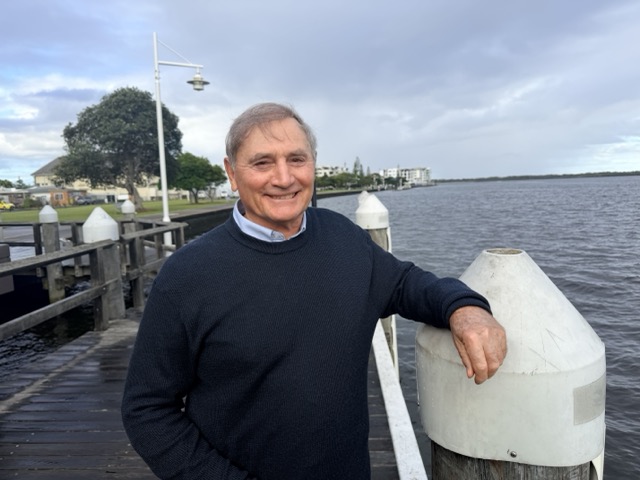
Award-winning wildlife filmmaker and Byron Shire councillor David Warth has become the first candidate to officially enter the race for the seat of Ballina ahead of the March 2027 NSW election.
The independent, who previously contested the federal seat of Richmond, says voters are increasingly looking for practical solutions rather than party ideology.
Warth, who was elected to Byron Shire Council in 2024, has spent decades filming wildlife around the world and has built a reputation as one of Australia’s leading environmental documentary makers.
We caught up with Warth over lunch at Ballina RSL Club, where he was already on the hustings.
As we made our way through the club, the first-term councillor appeared to be comfortable with already being on the hustings, stopping to have friendly chats with patrons and staff alike.
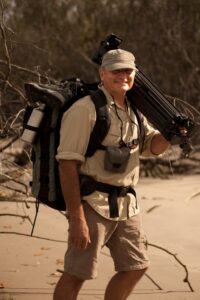
David Warth has built an international reputation as a wildlife filmmaker, documenting some of the natural world’s most spectacular sights.
Listening to Warth speak passionately about migratory shorebirds, wildlife and decades spent filming some of the natural world’s most spectacular sights, comparisons with Sir David Attenborough inevitably spring to mind.
Warth is an admirer of the celebrated British broadcaster.
“David Attenborough has done an amazing job of bringing the natural world to us,” he said.
But he was quick to point out that their views diverge on one of the defining political issues of our time.
“He has however been influenced by the climate change debate and has produced some sequences that have been misleading.”
Born at a British naval base in Malta and raised in the United Kingdom, Warth migrated to Australia in 1969 and eventually found his way to the Northern Rivers after a career that included farming, commercial fishing, more than 20 years as a professional abalone diver, tourism businesses and wildlife filmmaking.
He was first drawn to Byron Bay while making a documentary for ABC Television and quickly decided it was home.
The comments on climate provide an early insight into the political philosophy of the first declared candidate in what is shaping as a fascinating contest to replace retiring Greens MP Tamara Smith.
Warth said growing dissatisfaction with traditional party politics had encouraged him to run.
“I’ll never be part of a political party,” he said.
“I think people are looking for a fresh approach and somebody who is visible and accessible.”
He previously contested the federal seat of Richmond as an independent, polling more than 2,300 first preference votes.
Warth said his broad life experience would enable him to represent a wide cross-section of the electorate.
“This community has been very good to me,” he said.
“If there’s a chance for me to improve things and be of service, then I will.”
Housing affordability, key worker accommodation, infrastructure, health services and crime would all be priorities if elected, he said.
However, environmental issues remain closest to his heart.
Warth is currently working on a documentary titled Wild Byron, examining coastal ecosystems from Ballina to Brunswick Heads.
The project has highlighted what he believes is a little-known environmental crisis affecting migratory shorebirds.
Warth said species travelling thousands of kilometres from Siberia, Alaska, Mongolia and Japan were increasingly struggling to find suitable habitat along the Northern Rivers coast.
“They need places to feed, rest and roost at high tide, and many of those places are disappearing,” he said.
Among his concerns is the loss of important roosting habitat for migratory birds in the Ballina area.
He said an artificial island built in Lake Ainsworth to provide habitat for visiting shorebirds had gradually become overgrown with mangroves, forcing birds to seek alternative roosting sites.
Warth is also concerned about the declining health of the Richmond River.
“The Richmond River is a very sad story,” he said.
“Many years ago the river was actually the source of most of the fish on the coast.
“The biodiversity now is extremely low.”
Despite his strong environmental credentials, Warth insists he is not a single-issue candidate.
“I’m much more likely to be concerned with practical issues on the ground,” he said.
One issue likely to test Warth’s claim to occupy the political middle ground is the proposed Dunoon Dam.
While Ballina Mayor Sharon Cadwallader, who is reportedly considering her own independent run for the seat, has emerged as one of the dam’s strongest advocates, Warth remains unconvinced it is the right solution for the region’s future water needs.
The veteran environmental filmmaker said he accepted the Northern Rivers needed additional water storage, but was not yet prepared to back the controversial project.
“I totally acknowledge we need more water and it is a priority,” he said.
“But I would like to look at the whole situation and assess it for myself before making a final judgement.”
Warth stressed he was not opposed to dams in principle.
“We absolutely need to capture more water,” he said.
“Maybe not that specific site, but we do need to do some sort of water catchment work to supply these growing towns.”
The position places him at odds with Cadwallader on one of the Northern Rivers’ most contentious infrastructure projects and could prove a significant point of difference should the Ballina mayor also decide to enter the race.
Warth said voters were increasingly looking for practical solutions rather than ideology.
“I think our community is over party ideologies,” he said.
“They want somebody who’s available and visible and somebody who’s actually a people person.”